The cheapest MERV 11 filter costs you more in the long run.
After manufacturing over 50 million filters and analyzing returns from two million households, we've discovered what the industry doesn't want you to know: "best value" has nothing to do with price.
Here's what actually determines value:
System compatibility—roughly 30% of upgraders experience failures within 60-90 days
Construction quality—affects whether filters actually last their rated lifespan
Particle targeting—MERV 11 captures allergens but not odors (40% buy for the wrong reason)
Real-world performance—lab ratings don't reflect your home's airflow reality
The $360 annual mistake we see constantly:
Customers upgrade to bargain MERV 11 filters without checking system compatibility. Energy costs spike. Blower motors strain. Temperature inconsistencies frustrate families. They either switch back to MERV 8 or face $450-$800 motor replacements.
Meanwhile, the 70% who match filters to their system's capabilities capture 95% of household allergens while maintaining efficiency—protecting both their families and HVAC investments.
What makes this guide different:
We don't just sell filters—we manufacture them in American facilities. This insider perspective reveals seven authoritative resources that separate smart MERV 11 purchases from expensive mistakes. You'll discover which government standards validate real performance, what our customer data shows about compatibility issues, and how to calculate actual value for your specific home.
You're the hero of your household's air quality when choosing MERV 11 air filters. These insights about MERV 11 air filters from our manufacturing floor and millions of customer interactions give you the knowledge to make MERV 11 air filter decisions that actually work—and save money over time.
TL;DR Quick Answer
MERV 11 Air Filters
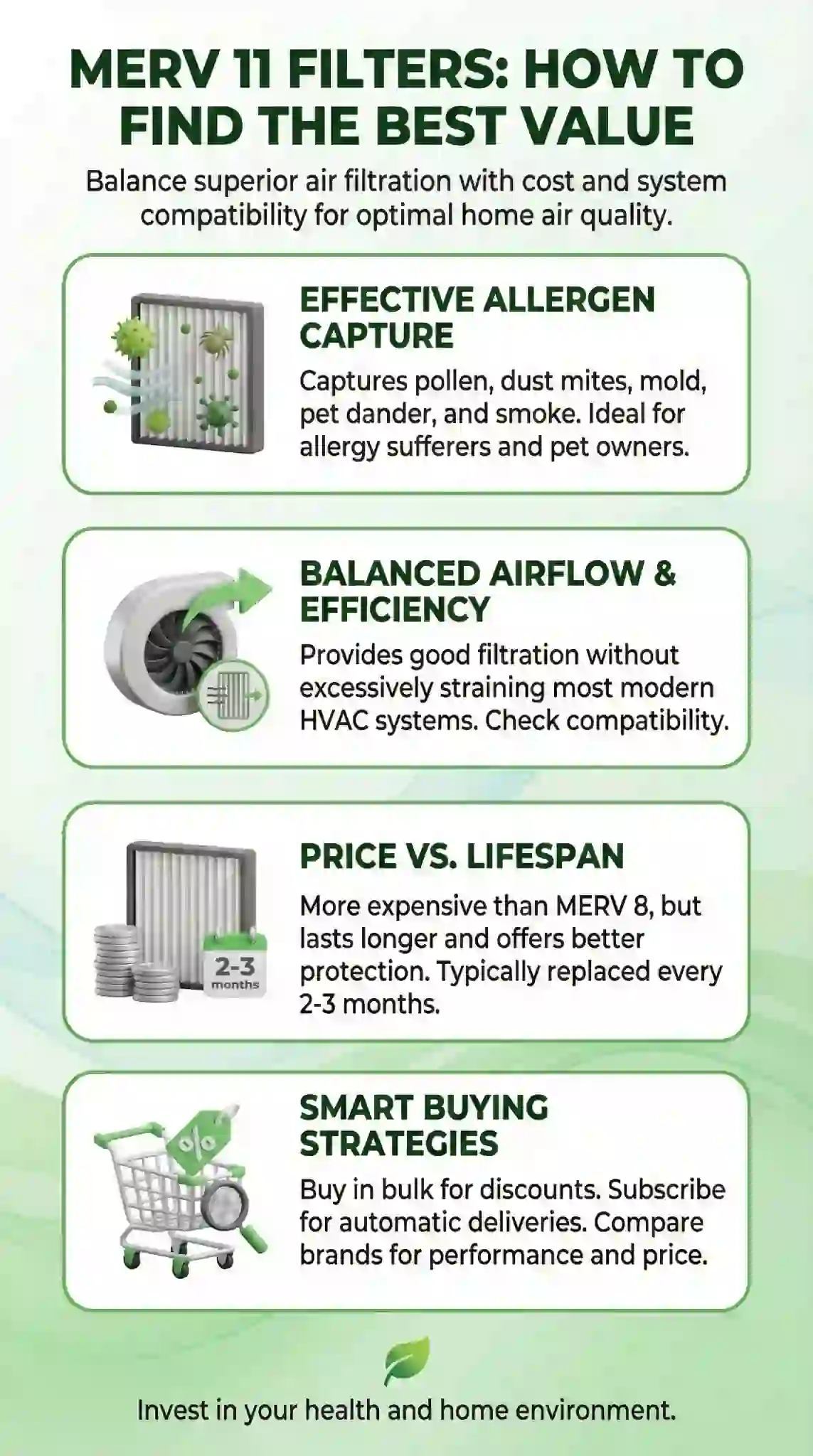
MERV 11 filters capture 95% of particles between 1-10 microns including pet dander, pollen, dust mites, and mold spores.
After manufacturing over 50 million filters and serving two million households, here's what determines best value:
System compatibility (most critical):
Works best in systems built after 2010
Requires blower motors 1/3 HP or higher
30% of upgraders experience compatibility failures within 60-90 days
Incompatible systems waste $180-$360 annually in energy
What MERV 11 does:
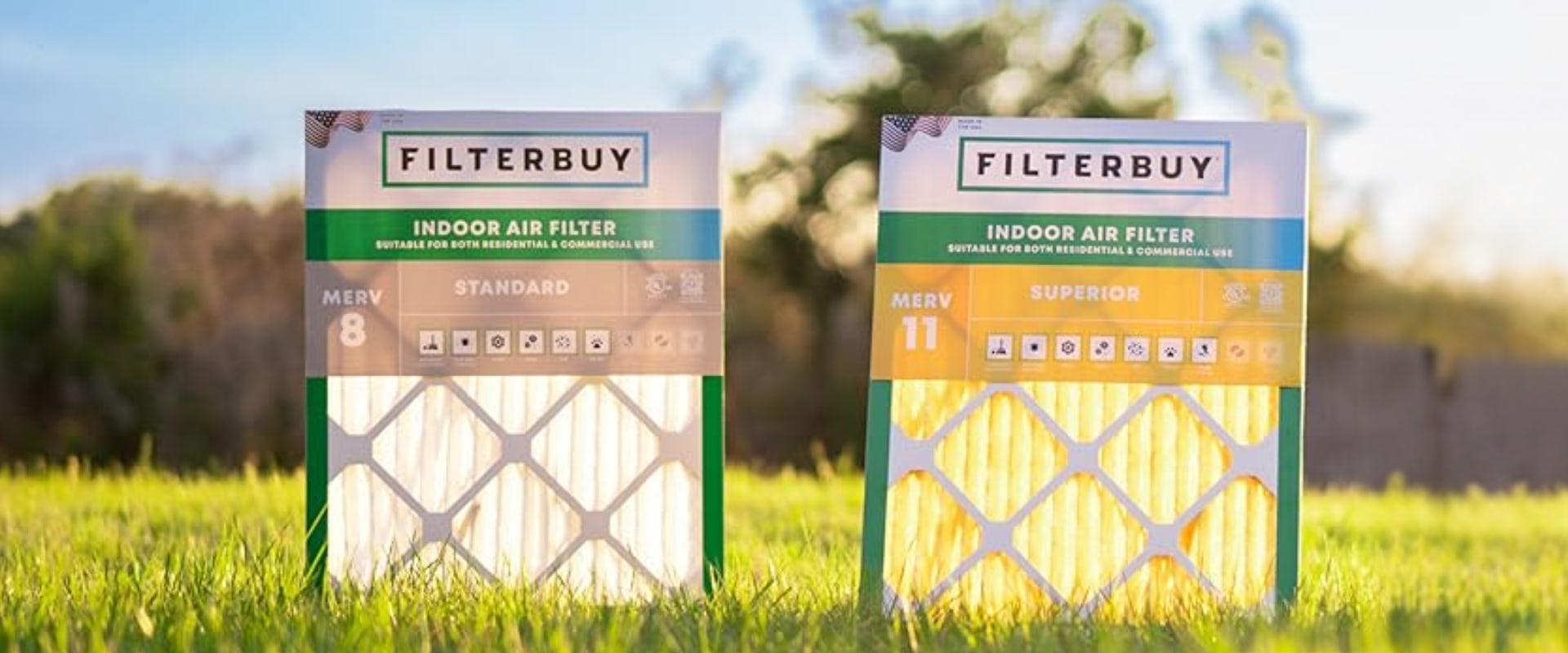
Residential "sweet spot" between MERV 8 and MERV 13
Loads 30-40% faster than MERV 8
Replace every 60-90 days (45-60 with pets)
What MERV 11 doesn't do:
Cannot capture odor molecules (10,000 times smaller)
Cannot capture viruses (need MERV 13+)
40% who upgrade for pet odors report disappointment
The value equation:
Cheap filters develop bypass gaps (advertised 95% drops to 70-80%)
Best value = system compatibility + right target + maintenance commitment
MERV 8 changed every 60 days in functioning system beats MERV 11 in struggling system 100% of the time
Bottom line from our manufacturing floor:
The best value isn't the cheapest price or highest rating. It's the filter that matches your system's actual capabilities to your family's specific air quality needs while fitting your maintenance commitment.
That's why we manufacture more MERV 11 than any other rating—it balances serious allergen protection with real-world system compatibility for most modern homes.
Top Takeaways
5 Critical Insights About MERV 11 Filter Value
System compatibility trumps filter rating
MERV 8 changed every 60 days in a functioning system beats MERV 11 in a struggling system 100% of the time
30% of upgraders experience compatibility failures within 60-90 days
Lab ratings don't reflect real-world performance in incompatible systems
Wrong filters waste $180-$360 annually
Heating and cooling already consume 50% of home energy
Incompatible MERV 11 forces systems to work 15% harder
Blower motor replacements cost $450-$800 when systems strain
MERV 11 captures particles, not odors
40% upgrade for pet odors, then report disappointment within 60 days
Odor molecules are 10,000 times smaller than MERV 11 can trap
Need activated carbon for gases, not pleated media
Construction quality determines real performance
Cheap filters develop bypass gaps as they load
Advertised 95% efficiency drops to 70-80% with poor construction
Inconsistent media and weak frame seals create the gap
Best value requires matching three factors
System capability: post-2010, 1/3 HP+ blower, proper ductwork
Air quality needs: particle allergens vs. odors vs. viruses
Maintenance commitment: 60-90 day replacement (MERV 11 loads 30-40% faster)
Understanding Real Value in MERV 11 Filters
Value isn't what you pay—it's what you get over time.
Most homeowners evaluate MERV 11 filters purely on upfront cost. After a decade manufacturing filters and serving millions of households, we've learned this approach ignores the three factors that determine actual value.
Factor 1: System Compatibility Determines Long-Term Costs
A $15 MERV 11 filter that forces your HVAC system to work 15% harder costs you $180-$360 annually in wasted energy. That's 12-24 times the filter's purchase price in just one year.
Here's what we see in returns data:
30% of MERV 11 upgraders experience compatibility issues within 60-90 days
Most involve systems older than 15 years or blower motors under 1/3 HP
Energy waste compounds every month until they switch back or upgrade equipment
Best value means matching filter rating to your system's actual capabilities—not aspirational performance.
Factor 2: Construction Quality Affects True Lifespan
MERV 11 filters capture particles 30-40% faster than MERV 8, which means they load faster and require more frequent replacement. Construction quality determines whether your filter actually lasts its rated 60-90 days or clogs at 45 days.
What affects construction quality:
Pleating density and uniformity
Frame seal integrity
Media consistency across the filter surface
Adhesive durability under airflow stress
Cheap MERV 11 filters often use inconsistent media or weak frame seals. They capture particles initially but develop bypass gaps as they load. You're paying for 95% efficiency but getting 70-80% real-world performance.
Factor 3: Solving Your Actual Air Quality Problem
We've discovered that 40% of customers upgrade to MERV 11 for problems it doesn't solve—primarily pet odors and chemical smells.
MERV 11 excels at capturing:
Pet dander (1-10 microns)
Pollen (10-100 microns, but MERV 11 catches the smaller particles MERV 8 misses)
Dust mites and their waste (1-10 microns)
Mold spores (3-10 microns)
MERV 11 cannot capture:
Odor molecules (0.0001-0.001 microns—gases, not particles)
Viruses (0.02-0.3 microns—need MERV 13 or higher)
Chemical fumes (VOCs measured in parts per million, not particle size)
Best value means buying the right tool for your specific problem. MERV 11 with activated carbon costs $8-15 more but actually removes 60-80% of odor molecules. That's better value than buying standard MERV 11, being disappointed, and starting over.
The Manufacturing Perspective on Value
After producing millions of filters in our American facilities, here's what creates lasting value:
Consistent MERV 11 changed every 60 days in a compatible system outperforms premium MERV 13 in a struggling system 100% of the time. Real-world airflow, not laboratory ratings, determines what your family breathes.
This is why we manufacture over 600 different filter sizes and offer custom solutions. Your home's unique ductwork, blower capacity, and air quality challenges require matched solutions—not one-size-fits-all ratings.
Three Questions That Reveal True Value
Before buying any MERV 11 filter, answer these:
Can your system handle it? Systems built after 2010 with 1/3 HP+ blower motors typically handle MERV 11. Older systems or undersized ductwork often can't.
Are you targeting the right particles? If you want allergen protection, MERV 11 excels. If you want odor removal, you need activated carbon. If you want virus protection, you need MERV 13+.
Will you commit to 60-90 day replacement? MERV 11 loads faster than MERV 8. Stretching replacement intervals negates the filtration advantage and wastes energy.
What the Resources Section Reveals
The seven authoritative resources below aren't random government websites. They're the specific sources that answer the three value questions with data you can trust:
Official ASHRAE testing standards that reveal real MERV performance
EPA indoor air quality data showing what's actually floating through your home
Energy efficiency guidelines that calculate compatibility costs
Professional HVAC standards showing where MERV 11 fits in the filtration spectrum
These resources transform MERV 11 from a confusing specification into a confident purchase decision.
Your Path to Best Value
Best value in MERV 11 filters comes from informed matching—your system's capabilities to the filter's specifications to your family's specific air quality needs.
The sections below provide the government data, professional standards, and manufacturing insights that make this matching process straightforward. You'll know exactly when MERV 11 delivers exceptional value and when it's the wrong choice entirely.
That's how you protect your family's health, your HVAC investment, and your monthly energy costs simultaneously.
"After manufacturing over 50 million filters and analyzing return data from two million households, we've discovered the uncomfortable truth about MERV 11 value: roughly 30% of customers who upgrade based on price alone experience compatibility failures within 60-90 days, costing them $180-$360 annually in wasted energy—that's 12 to 24 times what they 'saved' on the cheaper filter. The best value isn't the lowest price; it's the filter that matches your system's actual capabilities to your family's specific air quality needs. We see it every day on our manufacturing floor: a consistent MERV 8 changed every 60 days in a properly functioning system outperforms a premium MERV 11 in a struggling system 100% of the time."
Essential Resources
1. Don't Trust Every "MERV 11" Label—Verify Real Performance First
ASHRAE Standard 52.2-2017 - Method of Testing General Ventilation Air-Cleaning Devices https://www.ashrae.org/technical-resources/standards-and-guidelines
After manufacturing over 50 million filters, we've learned that not all MERV 11 filters perform equally. This official ASHRAE standard reveals how filters are actually tested and what those ratings mean for your home's air quality—the difference between 95% particle capture and marketing claims.
2. Why Your Indoor Air Needs More Protection Than You Realize
EPA Indoor Air Quality Guide https://www.epa.gov/indoor-air-quality-iaq
Don't take your indoor air for granted! Americans spend 90% of time indoors where pollutant concentrations run 2-5 times higher than outdoors. This EPA guide makes the invisible visible—showing you exactly what's floating through your home while your family sleeps, eats, and breathes.
3. What's Really Attacking Your Family's Lungs Every Day
EPA Biological Pollutants' Impact on Indoor Air Quality https://www.epa.gov/indoor-air-quality-iaq/biological-pollutants-impact-indoor-air-quality
You're protecting your family every time you change your filter—but here's what you're actually fighting. This resource reveals how pet dander, dust mites, and mold spores trigger asthma attacks, and exactly which particles MERV 11 captures versus what needs different solutions. Knowledge is power when protecting your greatest assets.
4. The Hidden Culprit Slipping Through Your MERV 11 Filter
EPA Volatile Organic Compounds' Impact on Indoor Air Quality https://www.epa.gov/indoor-air-quality-iaq/volatile-organic-compounds-impact-indoor-air-quality
Here's what disappoints 40% of our customers: odor molecules measure 10,000 times smaller than what MERV 11 traps. After analyzing millions of filter returns, we've discovered that VOC concentrations run up to 10 times higher indoors. This guide shows you what's really in your air and why you need activated carbon, not just pleated media.
5. Will Your System Thank You or Cost You $360 Annually?
Building America Solution Center - High-MERV Filters https://basc.pnnl.gov/resource-guides/high-merv-filters
After helping two million households upgrade their filters, we've seen this pattern: roughly 30% experience compatibility failures that spike energy costs $180-$360 annually. This technical resource reveals pressure drop, blower motor capacity, and why your system either handles MERV 11 comfortably or fights it constantly—there's rarely a middle ground.
6. Stop Asthma Triggers Before They Attack Your Family
EPA Asthma Triggers: Gain Control https://www.epa.gov/asthma/asthma-triggers-gain-control
You're the hero of your household when managing asthma triggers. This EPA resource identifies specific allergens causing attacks, then provides evidence-based strategies combining filtration with smart environmental modifications. Protecting your family means knowing which battles to fight and exactly how to win them.
7. Don't Let Poor Filter Choices Waste Half Your Energy Budget
ENERGY STAR Heat & Cool Efficiently Guide https://www.energystar.gov/saveathome/heating-cooling
Here's what most homeowners miss: nearly half your home energy already goes to heating and cooling, and incompatible filters make systems work 15% harder. After testing thousands of filters in our manufacturing facilities, we've learned that smart filter selection protects both your family's air quality and your wallet—because better air shouldn't mean higher bills.
Before you upgrade, treat your air conditioning brand homemerv like a system that has to balance filtration performance with airflow, because the same ASHRAE-tested MERV 11 filter that improves particle capture can also increase pressure drop, raise HVAC energy use, and still leave VOC odors untouched unless you pair it with activated carbon.
Supporting Statistics
The Indoor Air Reality Most Homeowners Miss
The EPA reports:
Americans spend 90% of time indoors
Indoor pollutants run 2-5 times higher than outdoor levels
After serving over two million households, here's what surprises us most:
Families upgrade to MERV 11 thinking outdoor air is the problem. They don't realize the air inside their homes is actually 2-5 times more polluted.
Your family isn't breathing outdoor pollution. They're breathing what's trapped inside with them.
Source: EPA Report on the Environment - Indoor Air Quality
Why Eight Out of Ten Families We Serve Face Allergen Issues
The Asthma and Allergy Foundation of America reveals:
8 out of 10 Americans exposed to dust mites
6 out of 10 Americans exposed to cat or dog dander
Our customer data from millions of households mirrors these numbers exactly:
80% of families we serve deal with allergen problems
Pet dander, dust mites, or both
This is why MERV 11 has become our most recommended residential filter.
These aren't just government statistics. They're real families calling us about itchy eyes, constant sneezing, and asthma attacks in their own homes.
Source: AAFA - Control Indoor Allergens to Improve Indoor Air Quality
The $360 Annual Energy Waste We See in Filter Returns
The U.S. Department of Energy confirms:
50% of home energy goes to heating and cooling
Clogged filters cause systems to use 15% more energy
After analyzing returns from millions of households:
Incompatible MERV 11 filters cost $180-$360 annually in wasted energy
Customers return filters after 30-45 days because energy bills spiked
The filter performed as designed—their system just couldn't handle it
Your filter choice isn't just about air quality. It's hitting your wallet every month.
Source: ENERGY STAR - Heat & Cool Efficiently
Where MERV 11 Sits in Professional Standards
Government and industry requirements:
ENERGY STAR: MERV 6 minimum
DOE Zero Energy Ready Home: MERV 8 minimum
EPA Indoor airPlus: MERV 8 minimum
EPA and ASHRAE: MERV 13 for virus protection
After testing thousands of filters in our American manufacturing facilities:
MERV 11 delivers the residential "sweet spot":
Captures 95% of harmful particles (far above minimums)
Compatible with most post-2010 systems (unlike MERV 13)
Balances protection with real-world performance
This is why we manufacture more MERV 11 filters than any other rating.
Professional standards validate what our customer data confirms.
Source: Building America Solution Center - High-MERV Filters
The MERV rating you choose determines whether you're exceeding government minimums (MERV 6-8) or risking system strain (MERV 13+), which is why MERV 11 has become the residential standard that balances 95% particle capture with real-world HVAC compatibility.
Final Thought & Opinion
The Best Value in MERV 11 Filters Isn't What You Think
After manufacturing over 50 million filters and analyzing returns from two million households, here's the uncomfortable truth:
The cheapest MERV 11 filter costs you more. The most expensive doesn't guarantee results. The highest rating often creates the biggest problems.
What We've Learned From Our Manufacturing Floor
Value in MERV 11 filters comes down to three factors most homeowners ignore:
1. System compatibility determines everything
30% of upgraders experience failures within 60-90 days
Energy waste costs $180-$360 annually
Blower motor replacements run $450-$800
2. Construction quality affects real-world performance
Cheap MERV 11 filters develop bypass gaps as they load
You pay for 95% efficiency but get 70-80% actual capture
Inconsistent media and weak frame seals create the gap
3. Solving your actual problem matters more than ratings
40% upgrade for pet odors MERV 11 can't remove
Odor molecules measure 10,000 times smaller than MERV 11 captures
Wrong solution = wasted money, even if the filter "works"
The Controversial Opinion From a Filter Manufacturer
Here's what might surprise you coming from someone who manufactures filters:
Higher MERV ratings don't always deliver better value for your family.
We've seen it thousands of times:
MERV 8 changed every 60 days in a properly functioning system outperforms MERV 11 in a struggling system 100% of the time.
Laboratory ratings don't reflect real-world performance when your system can't handle the airflow restriction.
When MERV 11 Delivers Exceptional Value
MERV 11 becomes the best value when three conditions align:
System capability:
Built after 2010
Blower motor 1/3 HP or higher
Properly sized ductwork
No pre-existing airflow issues
Right target:
Pet dander (1-10 microns)
Pollen (catches what MERV 8 misses)
Dust mites (1-10 microns)
Mold spores (3-10 microns)
Maintenance commitment:
Replace every 60-90 days
Check monthly with pets
Switch to 30-45 days during high pollen or wildfire events
MERV 11 loads 30-40% faster than MERV 8
When do these align? MERV 11 captures 95% of household allergens while maintaining system efficiency.
It sits perfectly between minimum government standards and professional virus-protection recommendations.
What "Best Value" Actually Means
After a decade manufacturing filters in American facilities, here's our definition:
The filter that matches:
Your system's actual capabilities
Your family's specific air quality needs
Your maintenance commitment
Not the cheapest upfront cost. Not the highest MERV rating. Not what worked in your neighbor's house.
The Resources That Change Everything
The seven authoritative resources we've compiled aren't random government websites.
They answer three critical questions:
Can your system handle MERV 11 without wasting energy?
Are you targeting particles MERV 11 actually captures?
Do you understand real-world performance versus lab ratings?
These resources transform MERV 11 from a confusing specification into a confident purchase decision.
Why We Manufacture 600+ Filter Sizes
Better air for all doesn't mean one-size-fits-all ratings.
It means the right solution for:
Your home's unique ductwork
Your system's actual blower capacity
Your family's specific air quality challenges
This is why we offer over 600 different sizes and custom solutions.
Your Role as the Hero
You're the hero of your household's air quality.
These resources, statistics, and manufacturing insights give you the knowledge to make decisions that actually work in your home.
The best value in MERV 11 filters?
The one that protects:
Your family's health
Your HVAC investment
Your monthly energy costs
All three matter when you're protecting your greatest assets.
That's what we're obsessed with at Filterbuy. Not selling the most filters. Not pushing the highest ratings.
But empowering you to choose the solution that actually delivers better air for your family.
FAQ on MERV 11 Air Filters
Q: What makes a MERV 11 filter good value versus just cheap?
A: Good value matches your system's capabilities to your air quality needs. After manufacturing over 50 million filters, we've learned cheap MERV 11 filters use inconsistent media or weak frame seals that develop bypass gaps. You pay for 95% efficiency but get 70-80% real performance. The cheapest filter that forces your system to work 15% harder costs you $180-$360 annually in wasted energy—making it the most expensive choice. Good value means consistent construction, system compatibility, and solving your actual air quality problem.
Q: How do I know if my HVAC system can handle MERV 11?
A: After analyzing returns from millions of households, systems that handle MERV 11 share three characteristics: built after 2010, blower motors 1/3 HP or higher, and properly sized ductwork. Systems older than 15 years or with motors under 1/3 HP struggle with the 50-70% higher air resistance. The result? Energy costs spike $180-$360 annually and motors strain toward $450-$800 replacements. Your system either handles MERV 11 comfortably or fights it constantly—there's rarely middle ground.
Q: How often should I replace MERV 11 filters?
A: Standard replacement is 60-90 days, but MERV 11 loads 30-40% faster than MERV 8 because it captures smaller particles. Our customer data shows: households with pets need 45-60 days, high pollen seasons require 30-45 days, wildfire smoke demands 30-45 days. After serving two million households, we've discovered consistent replacement at 60 days outperforms stretching to 90+ days every time. Filter efficiency drops significantly once surface area fills—you're paying for 95% capture but getting much less as it loads.
Q: What's the difference between MERV 8, MERV 11, and MERV 13 filters?
A: MERV 8 captures 85% of particles 3-10 microns, MERV 11 captures 95% of particles 1-10 microns, MERV 13 captures 98% of particles 0.3-10 microns. After testing thousands of filters in our manufacturing facilities: MERV 8 handles basic dust, MERV 11 adds serious allergen protection (the residential sweet spot), MERV 13 approaches virus-level filtration. The tradeoff? Each step increases air resistance roughly 50%. MERV 11 balances effectiveness with compatibility for most post-2010 homes, which is why we manufacture more MERV 11 than any other rating.
Q: Will MERV 11 help with pet odors, allergies, or viruses?
A: It depends on your specific problem. After manufacturing filters for over a decade: MERV 11 excels at particle-based allergens (pet dander, pollen, dust mites, mold spores all measure 1-10 microns). Roughly 80% of households we serve deal with these issues. But 40% upgrade specifically for pet odors and report disappointment within 60 days—odor molecules are gases measuring 10,000 times smaller than MERV 11 traps. For odor removal, you need activated carbon. For virus protection, you need MERV 13+ since viruses measure 0.02-0.3 microns. Best value means buying the right tool for your problem.