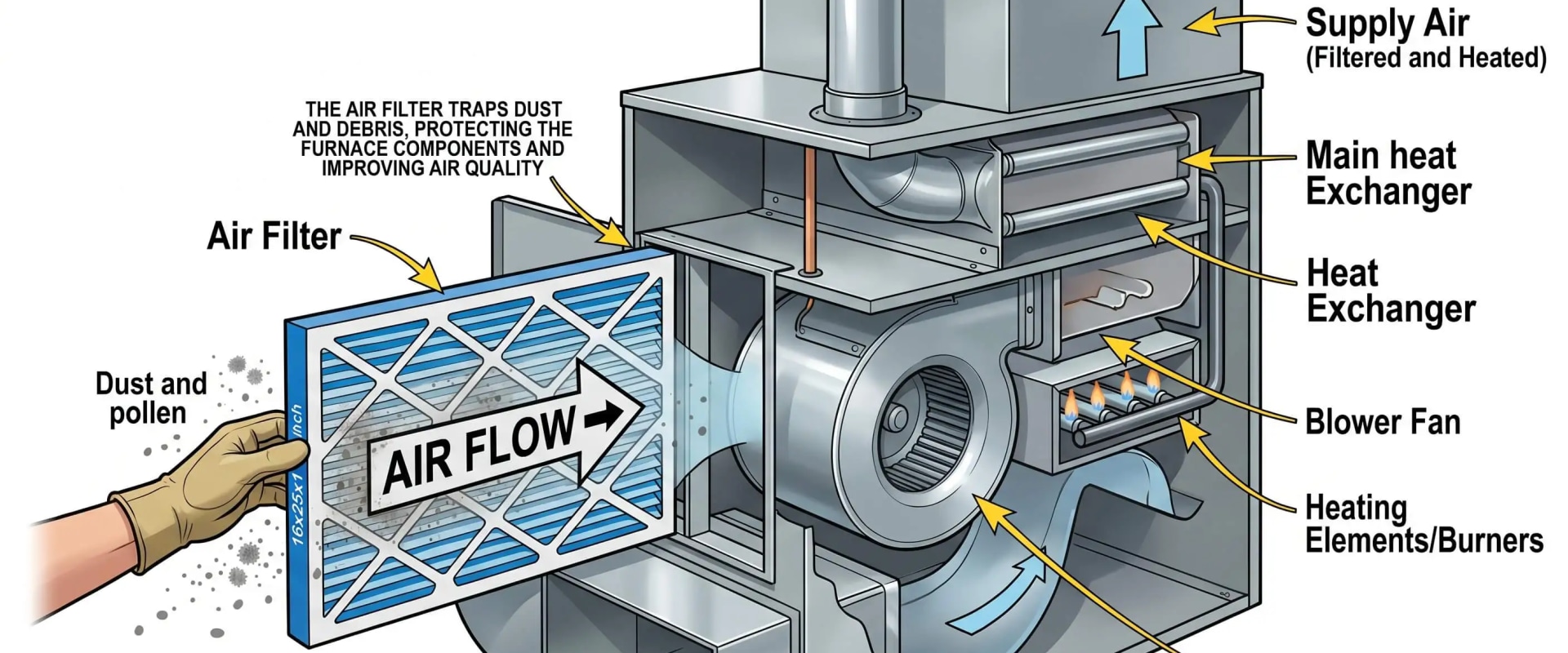
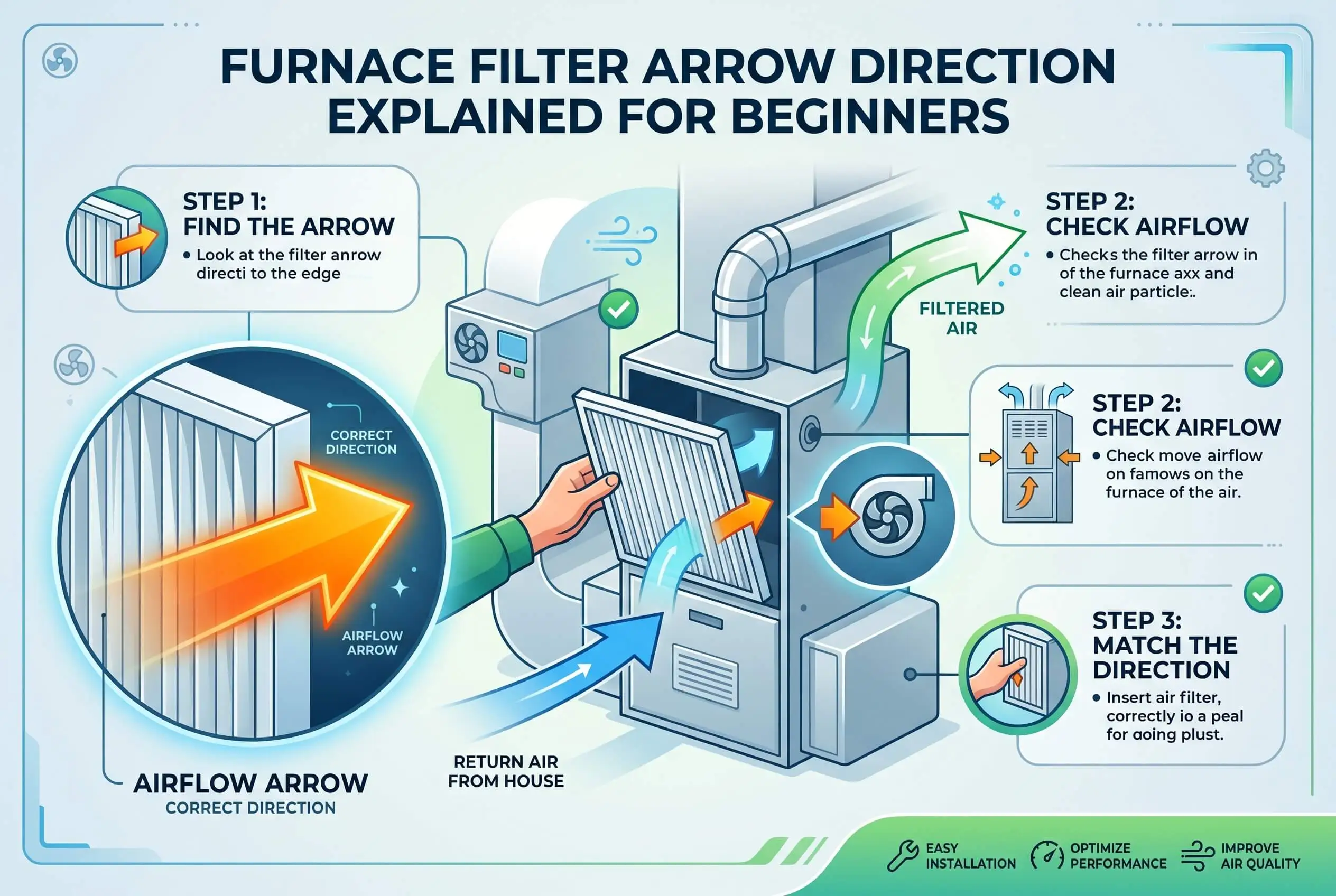
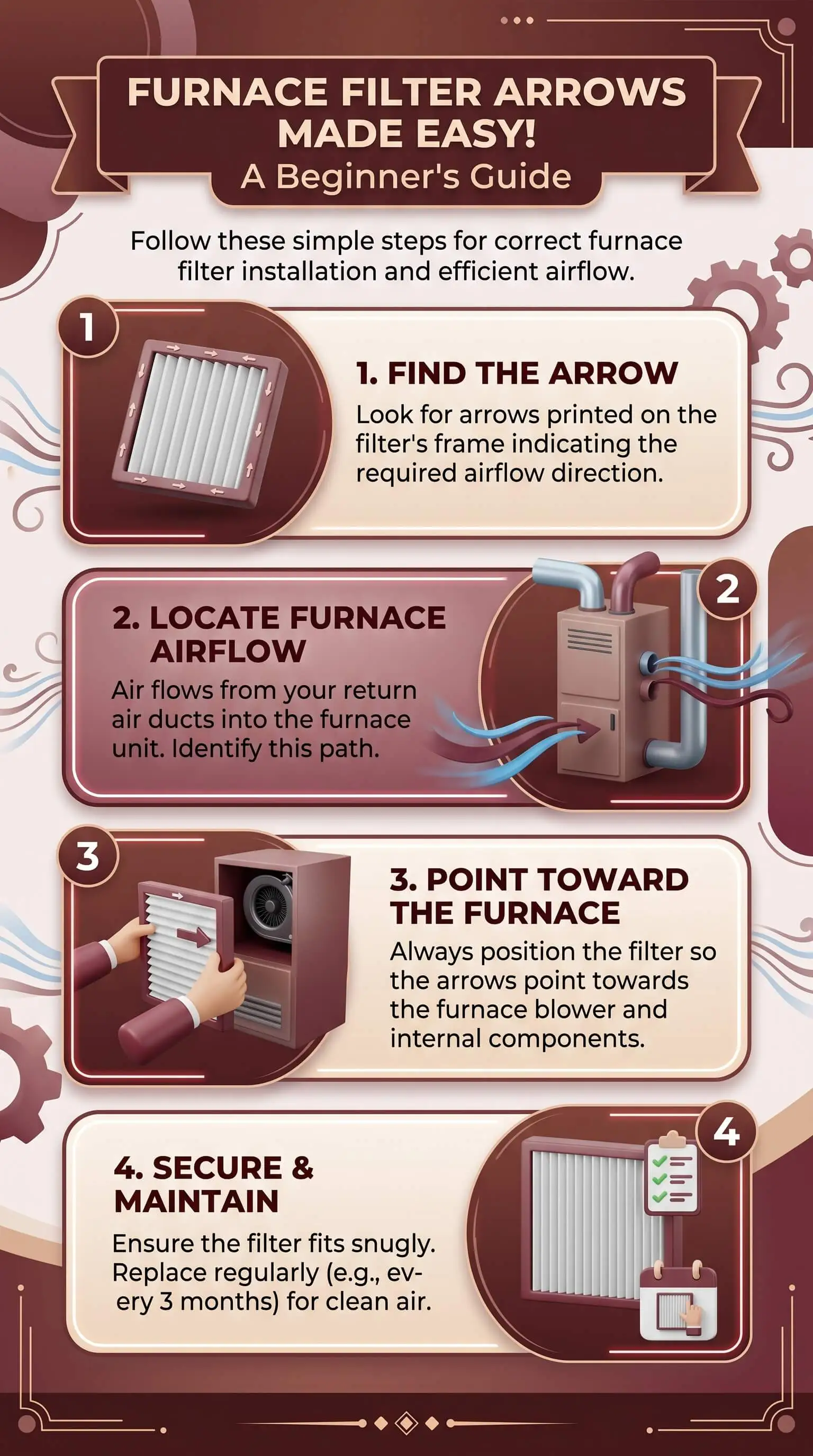
A few times a month, we walk into a home where the homeowner has just installed a brand-new furnace filter backwards. They are usually still standing right there, asking why the system has been running louder than it used to. The answer is printed right on the side of the filter. A single arrow. It points the way air flows through the system, which means it always points toward the blower motor. That orientation answers which way does air filter go in furnace and covers ninety-nine percent of what matters about furnace filter installation.
TL;DR Quick Answers
which way does air filter go in furnace
The arrow on the side of every furnace filter points toward the blower motor, in the direction air flows through your system. In our service-call experience, this single rule covers ninety-nine percent of correct installations. If your filter has no printed arrow, the lofted side faces the return and the dense side faces the blower.
Arrow direction: Always points toward the blower motor.
Air path: Return vent, filter, blower, ductwork, rooms.
By furnace type: Upflow points up, downflow points down, horizontal points sideways toward the blower side of the cabinet.
No printed arrow? The lofted side faces the return, dense side faces the blower.
Memory rule: The arrow flies toward the fan.
Top Takeaways
The arrow always points toward the blower motor. That is the direction air flows through the system after passing through the filter.
Furnace orientation changes which physical direction that arrow points. Upflow points up, downflow points down, horizontal points sideways toward the blower side of the cabinet.
A backwards filter does not break anything immediately. Pressure climbs over weeks and months, efficiency falls, and the blower motor wears out faster than it should.
No printed arrow on the filter? Follow the airflow itself — the lofted side faces the return, the dense side faces the blower.
Replace every one to three months during heavy heating or cooling seasons to keep airflow and filtration strong.
Why the Arrow Points Where It Does
A furnace filter looks symmetrical, but the two faces are doing different jobs. The intake side, which faces incoming air, uses a lofted, open weave that grabs larger debris like lint and pet hair before they pack down. The blower side is denser and finer, built to trap the small particles that would otherwise reach the motor and heat exchanger.
Residential furnace filters use pleated paper filter elements, folded into accordion ridges that multiply surface area without choking airflow. Slide one in backwards and air hits the dense side first. The blower has to work harder to pull the same volume of air, and the lofted layer that should be catching big debris is now downstream of where it can do any good.
Furnace Orientation and Arrow Direction
Three furnace configurations cover almost every home we service, and furnace filter replacement stays simple once you know the rule is the same for all three. The arrow points toward the blower. What changes is which physical direction the blower happens to be in.
Upflow furnaces sit in basements and utility closets, with the blower mounted above the filter slot. Return air enters at the bottom and rides up through the filter into the blower. Arrow points up.
Downflow furnaces flip that around. They show up most often in attic installations and some closet setups where the blower sits below the filter and air pushes down through the system. Arrow points down.
Horizontal furnaces sit on their sides in crawl spaces and tight mechanical closets. Air moves sideways across the filter instead of vertically. The arrow points toward whichever end of the cabinet houses the blower.
What Happens If You Install It Backwards
Nothing dramatic happens right away, which is why most homeowners can run a reversed filter for weeks before noticing anything is off. The system still moves air, and the thermostat still calls for heat or cooling. What is actually happening stays hidden until somebody looks for it.
Manufacturers rate pleated media at a specific pressure drop across the correct face. Reverse the filter and that pressure drop spikes. The blower compensates the only way it knows how — by running longer cycles to move the same volume of air. Longer cycles mean higher utility bills and faster wear on the motor. The dense layer that was supposed to trap the smallest particles is now upstream. The lofted layer ends up doing work it was never designed to do, and fines bypass everything on their way to the coil.
For a deeper step-by-step furnace filter installation breakdown, the linked guide walks through every variant we run into in the field.
What to Do When Your Filter Has No Arrow
A handful of budget fiberglass filters and most reusable washable models ship without any printed arrow at all. The rule still works, though. You just have to read the filter directly instead of the label.
Hold the filter up to a light. The lofted, more open side faces the return vent, and the denser, tighter side faces the blower. If there is a wire mesh or cardboard backing, that side typically faces the blower as well — it is the structural side meant to handle the suction load. When you cannot tell, follow the airflow itself: return vent, through the filter, into the blower, out into the ductwork, and into the rooms. Real or implied, the arrow always points downstream toward the fan.
Quick Pre-Install Checklist
We use the same five steps on every service call, and they work the same way for a homeowner:
Cut power at the thermostat and, if you can, at the breaker.
Open the filter slot or return grille and slide the old filter out.
Note the size printed on the frame and the direction the old arrow was pointing.
Slide the new filter in with the arrow pointed toward the blower.
Close the cabinet, restore power, and confirm the system starts normally.
If the new filter does not slide in cleanly, do not force it. Pull it back out, check the size against the old frame, and try again. Even a top furnace filter needs the right fit, because wrong sizes leave gaps around the perimeter that let air bypass filtration entirely, which is worse than a backwards filter.
“The first thing we check on a high-bill call is filter orientation. Roughly one in five homes we visit for efficiency complaints has a reversed filter in the slot. Once we flip it, the homeowner usually hears the system run quieter within an hour, because the blower stops fighting the dense side of the media. It is the cheapest fix in HVAC, and most homeowners have no idea it is even an option.”
7 Essential Resources
When homeowners want to read further, these are the outside references we send them to. Every link below goes to a federal agency, a research institute, or our own walkthrough — and every URL was verified live as of publication.
ENERGY STAR: Heat & Cool Efficiently. https://www.energystar.gov/saveathome/heating-cooling. EPA-backed guide to filter replacement cadence and HVAC efficiency basics.
ENERGY STAR: HVAC Maintenance Checklist. https://www.energystar.gov/saveathome/heating-cooling/maintenance-checklist. Official seasonal maintenance steps including filter, coil, and airflow checks.
U.S. Department of Energy: Air Conditioner Maintenance. https://www.energy.gov/energysaver/air-conditioner-maintenance. DOE guidance on how clogged filters drag down airflow and system efficiency.
EPA: Indoor Air Quality (IAQ) Home. https://www.epa.gov/indoor-air-quality-iaq. EPA's homeowner-focused IAQ hub covering ventilation, filtration, and source control.
EPA: Guide to Air Cleaners in the Home. https://www.epa.gov/indoor-air-quality-iaq/guide-air-cleaners-home. EPA breakdown of in-duct filtration and portable air cleaner options.
NIEHS: Indoor Air Quality. https://www.niehs.nih.gov/health/topics/agents/indoor-air. National Institute of Environmental Health Sciences overview of indoor pollutants and exposure research.
Filterbuy: Which Way Does a Furnace Filter Go? https://filterbuy.com/resources/air-filter-maintenance/way-furnace-filter-go/. Step-by-step installation walkthrough with orientation diagrams and troubleshooting.
3 Statistics
Up to 15 percent. Airflow problems alone can drop HVAC system efficiency by up to 15 percent, per ENERGY STAR's maintenance guidance. https://www.energystar.gov/saveathome/heating-cooling/maintenance-checklist
Every 30 to 90 days. ENERGY STAR recommends checking the filter monthly during heavy-use months and replacing it at least every three months, because a clogged filter slows airflow and forces the system to work harder. https://www.energystar.gov/saveathome/heating-cooling
90 percent. The EPA reports that Americans spend about 90 percent of their time indoors, where pollutant concentrations often run two to five times higher than typical outdoor levels. That indoor air is exactly what your furnace filter is sized to clean. https://www.epa.gov/report-environment/indoor-air-quality
Final Thoughts and Opinion
iest to undo. We have walked into homes where a twelve-dollar filter installed backwards cost the homeowner an entire season of system efficiency, even with a reliable air conditioning brand for home that is otherwise built to perform well. The arrow rule handles ninety-nine percent of these calls. The light test handles the rest. If we had to name the single most overlooked five-minute fix in residential HVAC, this would be it.
Frequently Asked Questions
Which way does the arrow on a furnace filter point?
Toward the blower motor, in the same direction air flows through your system. Upflow furnaces point the arrow up, downflow furnaces point it down, and horizontal installations point it sideways toward whichever end of the cabinet houses the blower.
Is there a wrong way to install a furnace filter?
Yes. When the arrow points away from the blower, the filter is reversed. The system still runs, but airflow drops and the blower has to work harder to compensate, which costs efficiency and shortens motor life.
Does the pleat direction matter?
No. Pleats can be faced either way without changing anything. The media is layered front to back, not top to bottom, so pleat orientation makes no difference. Only the airflow arrow matters.
What if my filter has no arrow on it?
Hold the filter up to a light. The lofted, more open side faces the return vent, and the denser, tighter side faces the blower. If there is a wire mesh or cardboard backing, that side typically faces the blower as well — it is the structural side meant to handle the suction load.
Can a backwards filter damage the furnace?
Yes, given enough time. A day or two of reversed installation will not break anything. Months of restricted airflow will strain the blower motor and can cause the heat exchanger to overheat, which shortens system life noticeably.
Next Step
Getting filter orientation right is one of the highest-impact ten-minute habits a homeowner can build. For the full walkthrough with orientation diagrams and troubleshooting for the trickier setups, the furnace filter installation guide picks up where we left off.
In an article about Furnace Filter Arrow Direction Explained for Beginners, it makes sense to connect the arrow-direction rule with choosing filters that match the furnace cabinet correctly, because beginners need both the right size and the right airflow orientation for the system to work properly. Options like 16x25x1 furnace filters, 25x25x1 HVAC air filters, and 20x22x1 furnace filters fit naturally into the topic because each filter still needs to slide in securely with the arrow pointing toward the blower, helping the furnace maintain steady airflow, cleaner filtration, and more efficient performance after every replacement.