That gap is particle size, and almost nobody explains it before you hand over three hundred dollars. Most buying guides rank these things by app design and battery life. Very few tell you what the sensor inside can physically detect, which turns out to be the only spec that matters.
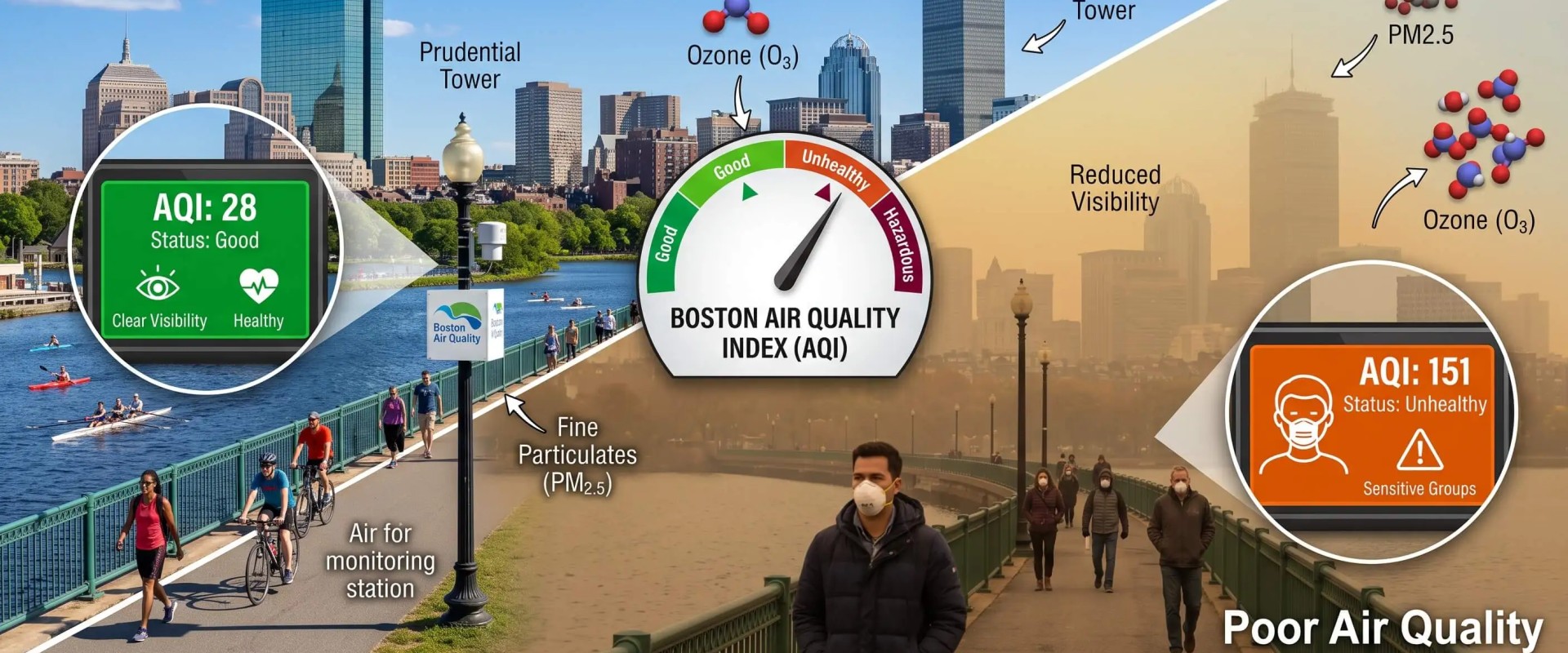
There’s one more thing to do before you shop. Checking air quality Boston gives you a useful outdoor baseline, so you can compare your indoor reading with what’s happening outside and make smarter choices for cleaner air at home.
TL;DR Quick Answers
Air Quality Boston
Boston's air quality shifts hourly with traffic on I-93 and I-95, summer ozone, and wildfire smoke drifting down from Canada. EPA AirNow gives the official reading. That number only predicts part of what you breathe, because indoor particulates from cooking and a sealed winter often runs higher than the air outside.
Official source: EPA AirNow at airnow.gov, pulling from MassDEP regulatory monitors across the state.
Neighborhood detail: PurpleAir updates block-by-block readings every two minutes, catching what citywide averages flatten out.
What moves the number: rush-hour traffic, afternoon ozone in summer, tree and ragweed pollen spring through fall, and smoke events arriving from thousands of miles away.
Act at 100, not 150: close the windows and switch your HVAC fan from Auto to On so the system filters continuously instead of only when it's heating or cooling.
Check inside too: a small kitchen with a gas range can push indoor particulates well past whatever the city reading says, and no outdoor index will warn you about it.
Top Takeaways
No home air quality monitor detects radon. It's the highest-stakes indoor pollutant in Massachusetts, and it needs its own device or a test kit.
A monitor is not an alarm. A carbon monoxide readout on a display carries no certification to wake you. Keep a real alarm on every level.
Price doesn't predict accuracy. The EPA says so directly, and independent testing puts correlation to reference instruments anywhere from near zero to 0.77.
A flat reading during cooking is often correct. Light-scattering sensors go blind below about a quarter micron, which covers boiling, steaming, and steady candle flames.
For Boston apartments, PM2.5 plus true NDIR carbon dioxide is the pairing that earns its keep. Small kitchens drive particulates, and a sealed winter drives carbon dioxide.
What Your Monitor Sees, and What It's Blind To
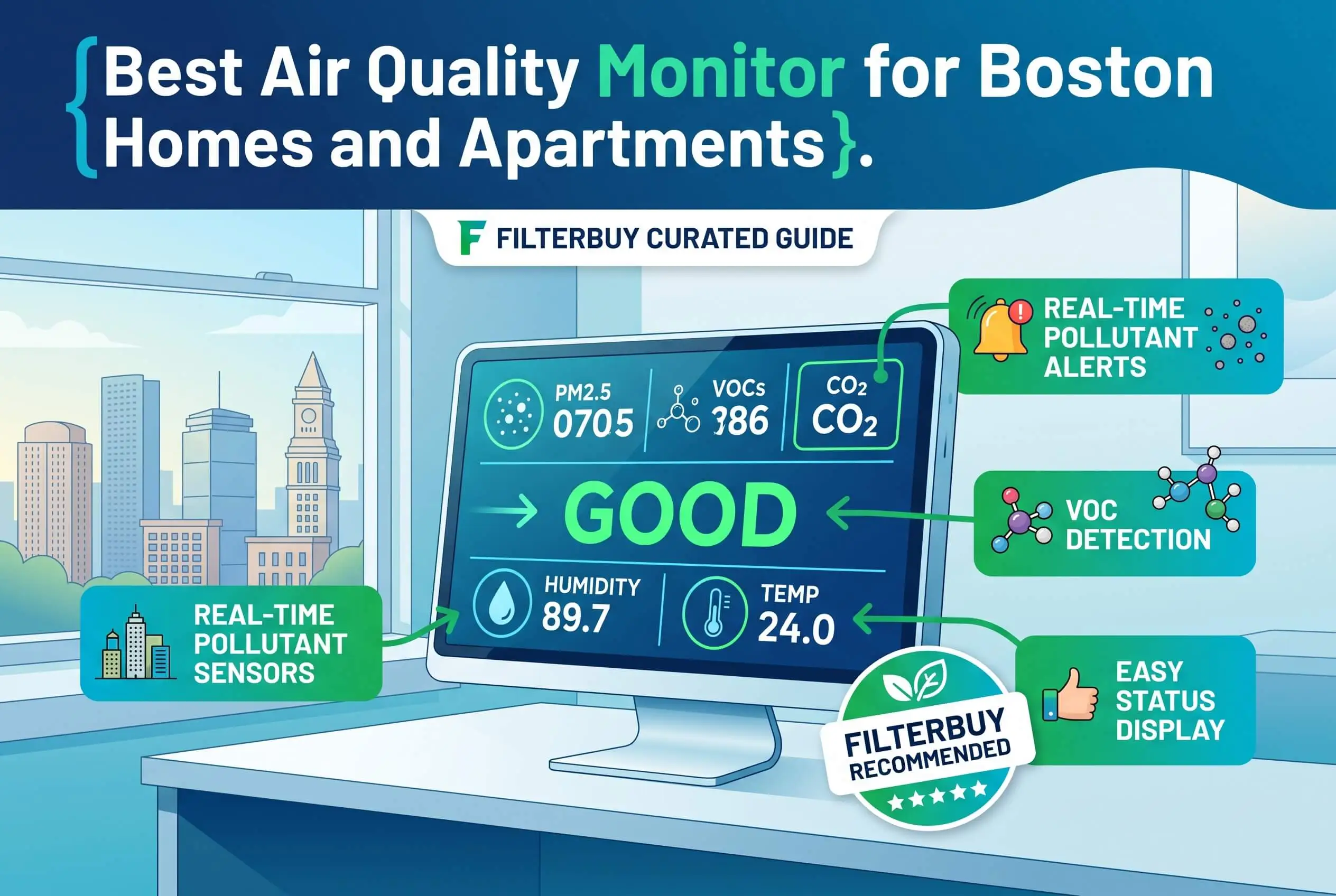
Most units under three hundred dollars track some mix of PM2.5, PM10, temperature, humidity, and either carbon dioxide or a general VOC index. A few add formaldehyde. That's a real slice of what's drifting through your home, and I don't want to undersell it.
Two of the things most likely to hurt a Boston household won't appear on any of those screens.
Radon is the first. No general-purpose air quality monitor detects it, and the EPA states that outright. You need a dedicated radon device or a mail-in test kit, and nothing on your shelf substitutes for one.
Carbon monoxide is the second, and this one catches people. The air quality index helps explain how polluted the outdoor air is and what that level may mean for your health, but plenty of monitors display a separate CO number. That number isn't an alarm. An alarm carries a certification to wake you at three in the morning. A monitor quietly logs a value and trusts that you're looking.
What's Actually Inside the Box
Particulate sensors at this price work by light scattering. A small laser fires across a stream of air, particles cross the beam and scatter it, and the device converts that scatter into an estimated mass concentration. Estimates are doing a lot of work in that sentence.
Shrink the particles far enough and there isn't enough scatter left to register. Somewhere around a quarter micron, the sensor goes blind. A steady candle flame puts nearly all of its mass down in that range, and so does a pot of water at a simmer. When your display sits flat through dinner, the odds are good that nothing's wrong with it. You're watching the edge of what light scattering can do.
Carbon dioxide sensors come in two kinds worth telling apart. NDIR measures CO2 directly by infrared absorption. That's the one you want. The other kind, usually labeled eCO2, never touches carbon dioxide at all. It infers a number from a VOC signal, which is a guess wearing a lab coat. Manufacturers rarely make that distinction easy to find, so check the spec sheet yourself.
VOC sensing at this tier is almost always metal oxide. The sensor heats a thin film and watches its electrical resistance shift when gases reach it. Something in the room changed. That's the whole message, and the sensor drifts over months of use besides, which is why air ionizer installation should be evaluated separately from what a VOC monitor is actually measuring.
Why Boston Housing Changes the Answer
Boston grew outward for three centuries by filling in tidal flats, and it now packs people more densely than nearly any large city in the country (Boston). Old buildings, close together, stacked three high. A large share of the housing stock is wood-frame triple-deckers built between the 1880s and the 1920s. Three units on three floors, with the kitchen usually at the back.
A national buying guide will never account for any of that. Here's how it should change what you buy.
Cooking dominates. Small kitchens, gas ranges, and range hoods that either recirculate the air straight back at you or don't exist. If you buy one sensor, make it PM2.5.
Winter concentrates everything else. Boston's average freezing window runs from early November to early April, and for most of that stretch nothing opens. Carbon dioxide climbs overnight in a closed bedroom. Radon climbs on the lower floors. An NDIR reading is the cheapest way I know to find out how badly a room is breathing.
Radon rises from the ground. It travels through basement joints, sump pits, and the gaps where utility lines pass through a foundation, so a garden-level or first-floor unit usually carries more exposure than a third-floor one in the same building. Usually. Two neighboring triple-deckers can read very differently, and upper floors aren't automatically clear.
For most Boston apartments, PM2.5 paired with a true NDIR carbon dioxide sensor is the combination that earns its keep. VOC is a pleasant extra. Radon and carbon monoxide need hardware of their own.
If You're Renting
Half of this decision changes when the unit isn't yours. That rules out anything requiring a drill, a hardwired connection, or a landlord's signature, which leaves plug-in and battery devices.
What you can do about a bad reading changes too. A tenant can't install a radon mitigation system, and Massachusetts has no regulation protecting occupants of existing homes from radon exposure. Nobody's going to compel your landlord on your behalf.
Test anyway. A documented number carries more weight with a property manager than a vague worry does, and it tells you exactly what to ask about the next place you look at.
Where to Put It, and What Will Lie to It
Breathing zone, three to six feet off the floor, in the room where you actually spend hours. Pull it a few inches off the wall so air reaches it from more than one direction.
Then keep it away from everything that will fool it. A monitor on the kitchen counter turns every dinner into an emergency. Park it near a bathroom door and it reacts to steam instead of particles. Set it beside a vent or an open window and it reports the draft rather than the room.
Give it a week before you conclude anything. The first genuinely useful thing one of these produces isn't an alarming spike. It's a baseline. You can't recognize an unusual day until you know what an ordinary one looks like in your own apartment, just as choosing the right air conditioning brand for your home starts with knowing what your space actually needs.
Glossary
PM2.5. Particles 2.5 microns across or smaller, fine enough to reach deep lung tissue.
PM10. Particles up to 10 microns. Dust, pollen, and larger debris.
Ultrafine. Anything below roughly 0.1 micron. Mostly invisible to consumer sensors.
pCi/L. Picocuries per liter, the unit for radon. The EPA action level sits at 4 pCi/L.
ppm. Parts per million, used for carbon monoxide and carbon dioxide.
NDIR. Non-dispersive infrared, a sensor that measures carbon dioxide directly.
eCO2. An estimated carbon dioxide figure inferred from a different sensor's reading.
MOX. Metal oxide, the usual VOC sensing method in consumer devices.
Breathing zone. Roughly three to six feet above the floor, where people actually inhale.
Semi-quantitative. A reading that moves in the right direction without being accurate in absolute terms.
"Nine times out of ten, when somebody tells me their new monitor is broken because it ignores their cooking, they're boiling or steaming, and nearly all of that mass sits under a quarter micron, which is below what a light-scattering sensor can register at all. I tell them to fry an egg instead, and the number moves inside a minute."
Seven Essential Resources
These are the sources I keep going back to. All federal or state, none of them selling anything, and every one will tell you something a product page won't.
The Federal Page That Tells You What Your Monitor Won't Catch
The EPA's guidance on low-cost monitors is the most useful thing published on this subject anywhere. It confirms that no widely accepted indoor performance criteria exist for these devices, that manufacturers set their own alert thresholds rather than following any health standard, and that price doesn't predict performance. Read it before you read a single review.
Source: https://www.epa.gov/indoor-air-quality-iaq/low-cost-air-pollution-monitors-and-indoor-air-quality
Independent Lab Testing on the Monitors You Can Actually Buy
Berkeley Lab's Indoor Environment Group runs consumer monitors against reference instruments while cooking bacon, burning incense, and shaking dust mops around a test house. It's the closest thing to a real-home evaluation anyone publishes. Their finding that several units miss ultrafine sources entirely is why I stopped trusting a flat display.
Source: https://indoor.lbl.gov/air-quality-sensors
Look Up Your Exact Model Before You Spend the Money
The Air Quality Sensor Performance Evaluation Center publishes laboratory and field reports on individual commercial sensors, with new ones added through this year. If the model you're eyeing has been tested, the report is sitting there for free. Two minutes in this database has talked me out of more purchases than any review site.
Source: https://www.aqmd.gov/aq-spec
The Massachusetts Radon Rules Your Monitor Will Never Mention
State health officials set the action threshold at 4 pCi/L and advise acting anywhere between 2 and 4. The page also names the two national bodies that certify testers and mitigators, and it confirms that no Massachusetts regulation protects occupants of existing homes. Tenants should read that last part before starting a conversation with a landlord.
Source: https://www.mass.gov/info-details/radon-in-homes
Why Particle Size Decides Whether It Reaches Your Lungs
This page explains what the number on your display actually represents. Indoor particulates can run higher than outdoor levels, size governs how deep a particle travels, and cooking and combustion drive most of what you'll measure at home. It reframes a monitor from a scorecard into a diagnostic tool.
Source: https://www.epa.gov/indoor-air-quality-iaq/indoor-particulate-matter
The Line Between a Monitor and an Alarm, in Plain Federal Language
Average carbon monoxide in a home without a gas stove runs half a part per million to five. Near a properly adjusted gas stove, five to fifteen. Near a poorly adjusted one, thirty or higher. Those three numbers tell a Boston renter with a gas range more than any product comparison will.
Source: https://www.epa.gov/indoor-air-quality-iaq/carbon-monoxides-impact-indoor-air-quality
How a Sealed Winter Home Concentrates Everything Inside It
Air exchange rate is the concept most people have never heard of and most need. When infiltration and ventilation drop, pollutant levels rise, and a building constructed to minimize leaks will hold higher concentrations than a drafty one. That's New England from November through April, described in a single paragraph by the federal government.
Source: https://www.epa.gov/indoor-air-quality-iaq/introduction-indoor-air-quality
Federal and state guidance shows that consumer air monitors have real limits, so pair their readings with proven steps like radon testing, proper ventilation, and regular HVAC system maintenance to better manage indoor air quality.
Supporting Statistics
These Devices Are Approximate by Design
Berkeley Lab tested six consumer monitors priced under three hundred dollars against 21 common household particle sources. Readings came back at roughly 50 to 200 percent of actual PM2.5. The units showed little or no response to any source whose mass fell entirely below 0.25 micron, including steady candle flames and cooking without frying or grilling.
Source: https://indoor.lbl.gov/publications/performance-low-cost-indoor-air
Massachusetts Radon Isn't a Rural Problem
Roughly 650,000 homes in Massachusetts sit above the EPA action level of 4 pCi/L. About 34,000 exceed 20 pCi/L. The EPA attributes 628 lung cancers in the state each year to radon. One home in four may cross the action level, and buildings with high readings turn up in every county.
Source: https://www.mass.gov/info-details/radon-get-the-facts
Accuracy Varies More Than Price Does
EPA field and laboratory work places consumer particulate sensors across a correlation range running from effectively zero to 0.77 against reference monitors. In one multi-sensor field study, data completeness ranged from 47 percent to 96 percent depending on the unit. Two devices at the same price can perform nothing alike.
Source: https://www.epa.gov/air-sensor-toolbox/evaluation-emerging-air-sensor-performance
Consumer air monitors can vary widely in accuracy, so use their readings as a guide, confirm risks like radon separately, and pair that insight with MERV 11 pleated HVAC furnace air filters to help reduce airborne particles indoors.
Final Thoughts and Opinion
My actual recommendation won't sell many monitors.
For most Boston households, the first purchase shouldn't be an air quality monitor at all. Buy a radon test and a working carbon monoxide alarm. Together they cost less than the cheapest monitor on the shelf, and they cover the two hazards that genuinely kill people in old New England housing. A monitor covers neither.
Buy the monitor second, and buy it for the right job. You can't do anything about the city's air. You can do quite a lot on your own. The night your bedroom carbon dioxide climbs past a thousand is the night you learn to crack a window. The dinner that spikes PM2.5 tells you your range hood is decorative.
That's where the value lives. A monitor that changes what you do is worth every dollar. One you check twice and forget is a gadget you paid for, and the difference comes down entirely to whether you understood what the sensor could see before you bought it and how pleated furnace filters fit into your overall indoor air quality strategy.
Frequently Asked Questions
What should an air quality monitor measure in a Boston home?
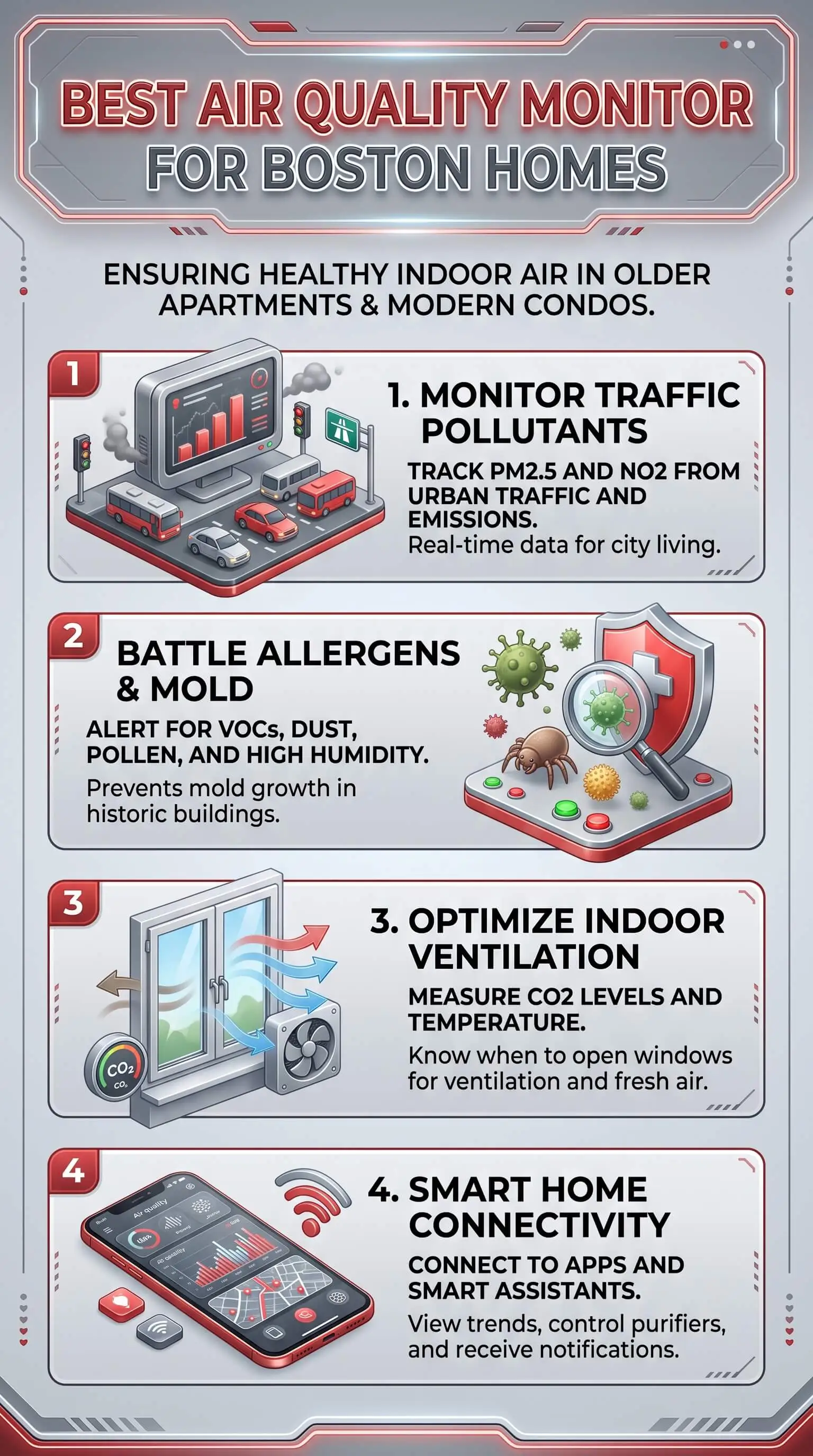
PM2.5 first. Small kitchens with gas ranges and weak hoods make cooking the dominant particulate source in most units here, which is where high quality air filters can make a meaningful difference indoors. Carbon dioxide second, measured by a true NDIR sensor rather than an estimated figure, because the heating season keeps windows shut for months at a stretch. Everything beyond those two is optional.
Are inexpensive air quality monitors accurate?
They're semi-quantitative. They move in the right direction and catch real events, but treat the absolute number as a ballpark. Independent testing found consumer units reading anywhere from half to twice the actual particulate concentration, which is still plenty useful for spotting patterns in your own home.
Does an air quality monitor replace a carbon monoxide alarm?
No. Carbon monoxide alarms carry a certification to warn of a life-threatening situation and to wake a sleeping household. A monitor's CO readout is informational and carries nothing of the kind. Keep an alarm on every level of the home, outside each sleeping area.
Do I need a radon test on the upper floor of a triple-decker?
Yes, because radon exposure varies more by building than by floor. Concentrations usually run highest at the lowest level, but stack effect pulls soil gas upward through a wood-frame building all winter. Massachusetts health officials recommend testing every home, and two neighboring buildings can read very differently.
Where should I put a monitor in a one-bedroom apartment?
The bedroom, three to six feet up, a few inches off the wall. That's where you spend the most consecutive hours and where carbon dioxide buildup shows up most clearly. Skip the kitchen counter, the bathroom doorway, and anywhere within a few feet of a vent or window.
How do I compare my indoor reading to Boston's outdoor air?
Check the outdoor index first, then look at your indoor number. Low outside and high inside means the source is in your apartment and you can do something about it today. Elevated in both places means close the windows and let filtration carry the load.
Start With What Your Home Is Already Telling You
The best air quality monitor for your home is the one that measures what your building actually produces, and in a Boston apartment that usually means particulate from a small kitchen and carbon dioxide from a sealed winter. Test for radon, confirm your carbon monoxide alarm still works, then pick a monitor, pair it with the right HVAC solutions for your space, and give it a week to show you your own patterns.