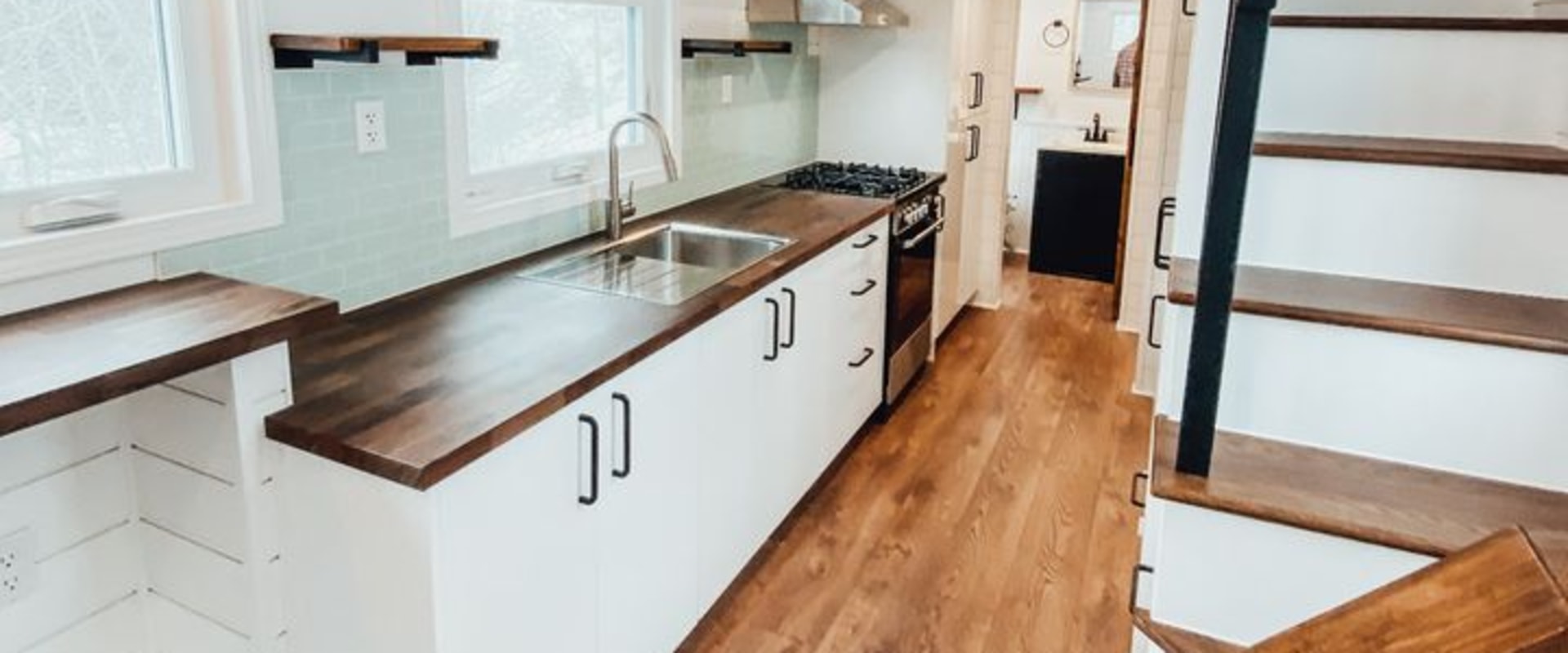
What makes the small-space case different isn’t obvious from a product spec sheet. A 400 sq ft tiny home holds about 3,200 cubic feet of air. An average single-family home holds closer to 18,400. That smaller air volume gives air filters a real advantage, because the right filter can cycle and clean the same indoor air more effectively in a compact space. Every indoor pollutant loads into a fraction of the volume a standard residential recommendation assumes, so well-matched air filters can make the home feel fresher, cleaner, and easier to breathe in day to day. After enough sub-500-square-foot setups, our advice on air filters looks pretty different from what shows up on a generic residential blog post.
TL;DR Quick Answers
air filters
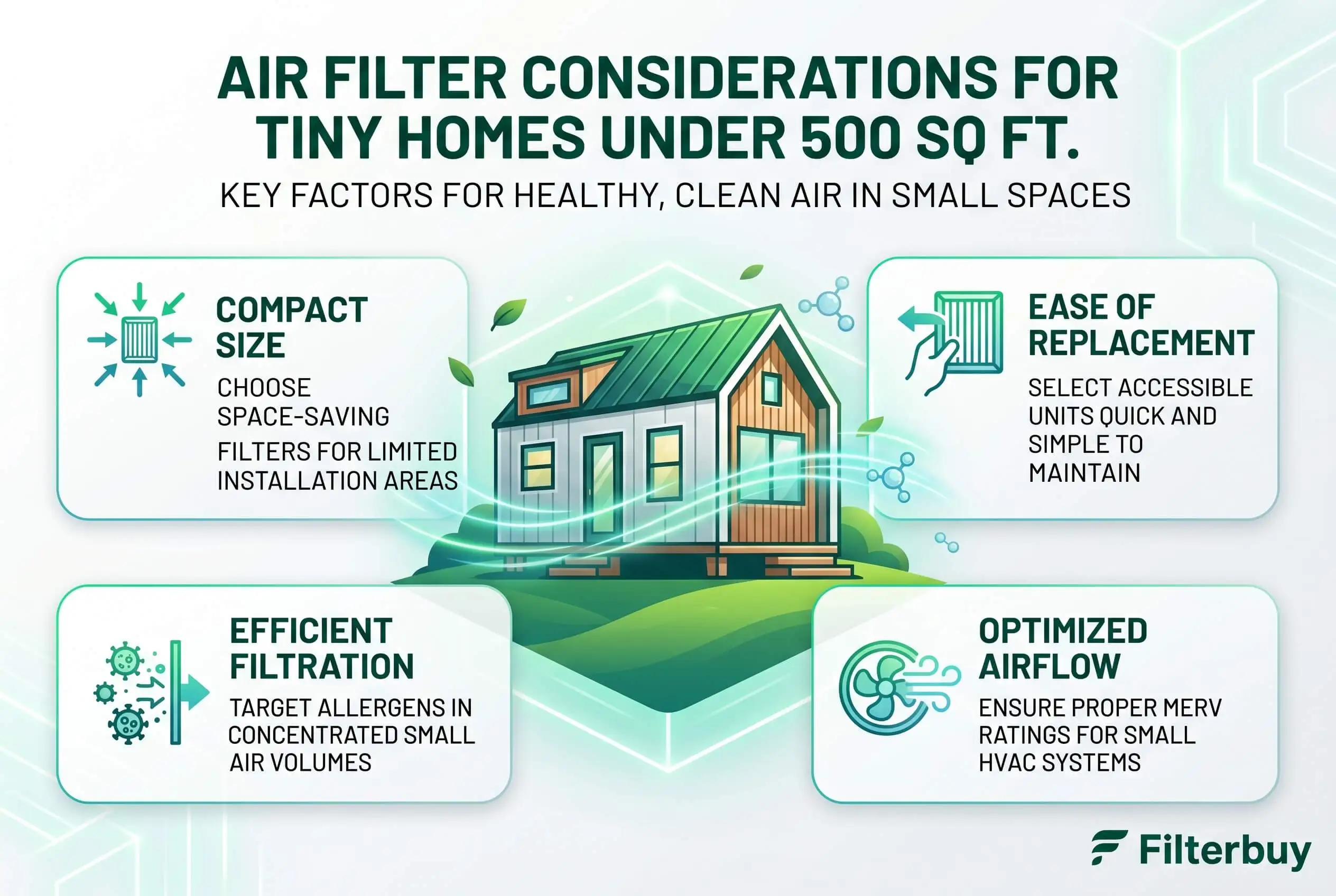
Air filters trap airborne particles like dust, pollen, pet dander, and smoke before they reach your lungs or your HVAC equipment. In our experience, picking the right top air filters comes down to two practical questions: what MERV rating your system can handle without choking, and what slot size fits the filter housing.
MERV rating: Most residential systems run best somewhere between MERV 8 and MERV 13. The right number depends on what your equipment can actually move air through without losing efficiency.
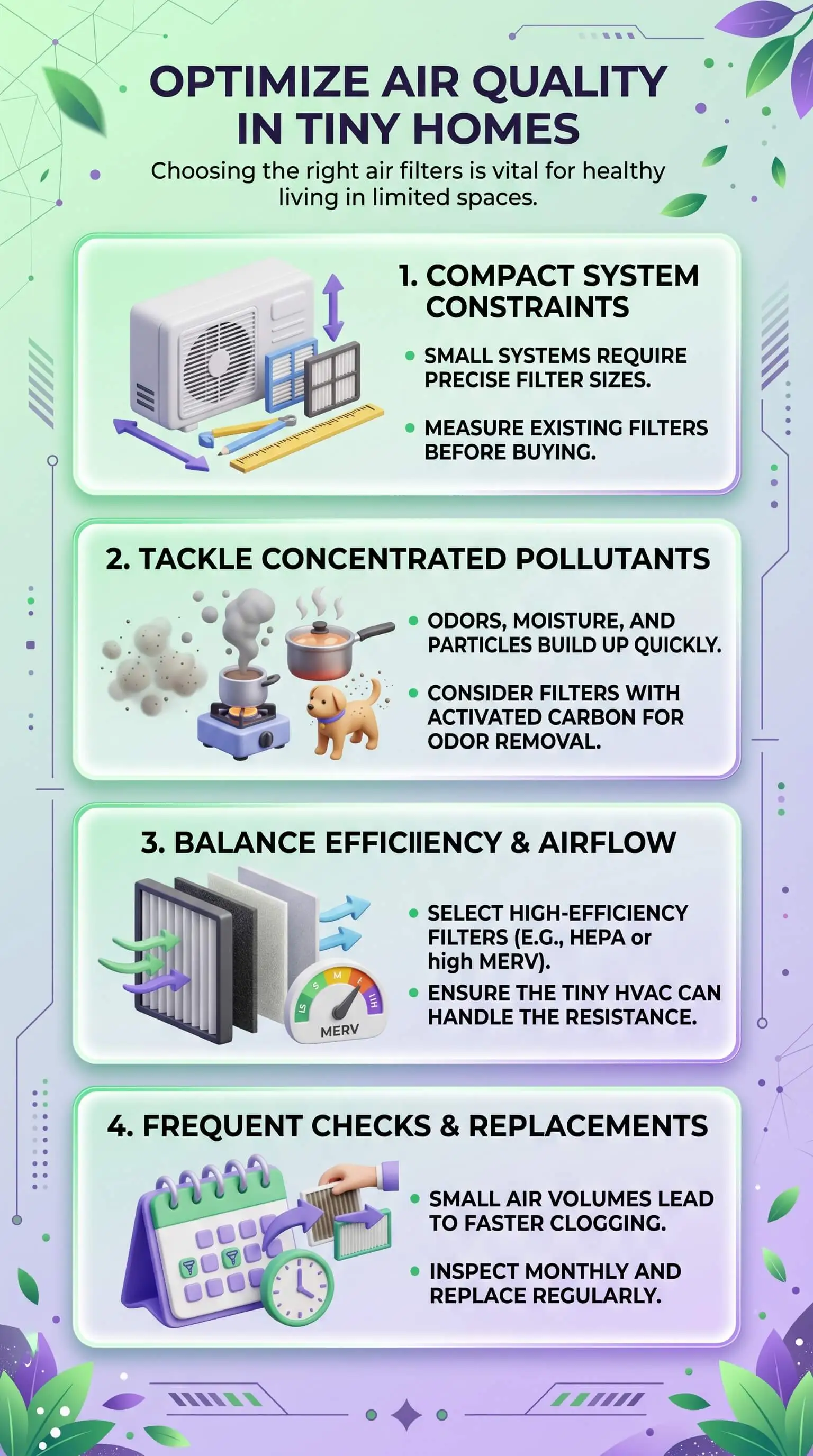
Replacement interval: A 1-inch pleated filter typically needs replacement every 60 to 90 days. Pets and heavy cooking shorten that further.
Sizing: The right size is printed on the side of your current filter or stamped inside the filter slot. Standard residential sizes are expressed in inches such as 16x20x1, and custom cuts handle non-standard slots.
Top Takeaways
A 400 sq ft tiny home contains roughly 3,200 cubic feet of air, about a fifth of an average single-family home, which concentrates every indoor pollutant.
Most tiny homes use ductless mini-splits, PTAC units, window units, or short-duct setups rather than central forced-air HVAC.
MERV 8 to 11 is the practical filter range for tiny home in-system filtration. MERV 13 typically overloads ductless static pressure.
Filter replacement intervals usually shorten to 45 to 60 days in tiny homes because indoor activity loads them faster.
A properly sized portable HEPA purifier outperforms aggressive in-system filtration in spaces this small.
Why Tiny Home Air Quality Behaves Differently
Cooking is the source we get asked about most. Searing a meal in a tiny home kitchen produces the same fine particulate matter as searing it in a 2,000 sq ft house, but the concentration in the air runs several times higher because there’s so much less volume to dilute it. Off-gassing from new finishes and furniture follows the same pattern. Wood stoves and indoor smoking compound it further.
For anyone new to filter mechanics, the Wikipedia overview on air filters walks through how filter media actually traps particles. It’s a useful primer for the rest of this guide.
Ventilation also has to work harder against that load. Standard residential guidance targets roughly 4 to 5 air changes per hour . In active tiny home use, we’ve seen the practical need run higher.
Matching the Filter to Your Cooling System
Most tiny homes don’t run forced-air central HVAC. Four configurations cover almost everything we see in the field.
Ductless mini-split systems
Common in foundation-built tiny homes and skoolies. The indoor head unit holds a washable mesh filter that protects the coil from larger dust. It doesn’t clean room air to fine-particle standards. Static pressure on these systems typically tops out around 0.2 to 0.5 inches of water column , which caps the practical MERV rating for supplemental filtration somewhere around MERV 8 to 11. Pushing higher chokes airflow and shortens compressor life.
PTAC units
Common in tiny homes on wheels. Filters are usually basic foam or aluminum mesh, designed to protect the coil from larger debris. Wash them every two to four weeks.
Window and portable AC units
The factory filter on these protects the coil but doesn’t clean the room air, and a standalone air cleaner does the real work in these setups.
Small-duct or no-HVAC setups
Some tiny homes run short duct runs with one or two registers and a 1-inch pleated filter slot. Common slot sizes include 14x14, 14x20, 16x20, and 20x20. For equipment that can handle it, MERV 11 is a sensible target. When the system can’t, a properly sized standalone HEPA does better than a high-MERV filter that strangles the blower.
Choosing MERV Rating Without Choking Your System
The MERV scale runs from 1 to 20. For most tiny home systems, the practical band sits between MERV 8 and MERV 11. MERV 8 picks up pollen and most mold spores, plus the larger end of dust mite debris. MERV 11 catches finer pet dander and a meaningful share of cooking-related particles. MERV 13, which the EPA recommends as the residential target for in-duct filters in standard homes, is usually too restrictive for ductless and small-duct equipment.
For MERV-13-equivalent particle removal in a tiny home, use a standalone HEPA purifier sized to your room volume rather than a high-MERV in-system filter. A true HEPA captures 99.97 percent of particles at 0.3 microns, and a properly sized portable unit outperforms what most tiny home HVAC systems can move through restrictive filtration anyway. For replacement filters in standard residential sizes, including the small-format options that fit short-duct tiny home setups, standard and custom-cut residential filter sizes are usually the path of least friction.
How Often to Replace Filters in a Tiny Home
The default 90-day interval most filter boxes print assumes a 2,000-plus sq ft home running a central system. In tiny home use, we’ve found air conditioner filters perform best when they get attention every 45 to 60 days because indoor activity loads them faster. That simple habit helps air conditioner filters keep airflow cleaner, steadier, and more comfortable in a compact space. Pets and wood stoves push that interval shorter still.
The most reliable indicator is visual. Pull the filter and hold it up to a light. If light won’t pass cleanly through the pleats, it’s done its job and earned a replacement, which is also a useful habit when choosing the right air conditioning brand for your home. Mini-split mesh filters should come out for washing every two to four weeks during active cooling season, monthly during shoulder seasons.
“The mistake we see most often in tiny home setups is owners running a MERV 13 filter through a ductless mini-split because someone told them MERV 13 is the residential standard. That system was never built to push that kind of resistance. The blower works harder than it should, and in humid weather you’ll see the coil start to ice. The setup that holds up over time is a MERV 8 in the system with a properly sized portable HEPA on the floor.”
Essential Resources
These pages are where we point owners who want to keep digging:
EPA, Guide to Air Cleaners in the Home: the agency’s plain-language consumer overview, covers HVAC filters and portable air cleaners side by side. epa.gov/indoor-air-quality-iaq/guide-air-cleaners-home
EPA, Air Cleaners and Air Filters in the Home: the technical hub page that links to the longer Residential Air Cleaners summary. epa.gov/indoor-air-quality-iaq/air-cleaners-and-air-filters-home
EPA, The Inside Story — A Guide to Indoor Air Quality: the foundational reference on indoor pollutant sources and exposure pathways. epa.gov/indoor-air-quality-iaq/inside-story-guide-indoor-air-quality
EPA, What Is a HEPA Filter?: a clear, sourced explanation of what HEPA actually means and how MERV ratings compare. epa.gov/indoor-air-quality-iaq/what-hepa-filter
ENERGY STAR, Ductless Heating and Cooling: the certification page for mini-splits, useful for matching equipment to climate and load. energystar.gov/products/ductless_heating_cooling
DOE Energy Saver, Ductless Mini-Split Air Conditioners: the federal guide to mini-split applications, sizing, and limitations. energy.gov/energysaver/ductless-mini-split-air-conditioners
CDC NIOSH, Ventilation and Respiratory Viruses: covers ventilation strategy and air cleaning principles that translate cleanly to small-space settings. cdc.gov/niosh/ventilation/about/index.html
Supporting Statistics
Indoor air pollutants typically run two to five times higher than outdoor levels, and sometimes exceed outdoor concentrations by a hundredfold. The EPA traces this gap to a combination of indoor pollutant sources and tighter building envelopes. In a tiny home, the ratio compresses further because the air volume diluting any single source is so much smaller. Source: EPA, The Inside Story — A Guide to Indoor Air Quality.
Americans spend about 90 percent of their time indoors, which makes indoor air quality directly relevant to overall pollutant exposure. The EPA cites this figure across multiple guidance documents. Source: EPA, Guide to Air Cleaners in the Home.
A true HEPA filter must remove at least 99.97 percent of airborne particles at 0.3 microns, the most penetrating particle size. Particles both larger and smaller than 0.3 microns get captured at even higher rates, which is part of why HEPA-class portable purifiers work so well in small-volume spaces. Source: EPA, What Is a HEPA Filter?.
Final Thoughts
Tiny home filtration deserves its own conversation. The systems differ from what standard residential advice assumes, and the smaller air volume concentrates every indoor pollutant source. The right answer for a tiny home sits well away from a typical 2,000 sq ft recommendation. A high-MERV filter chokes a mini-split that was never built to push that much resistance, and the result is worse comfort and shorter equipment life, not better air.
After enough small-space service calls, we keep landing on the same pairing as the most reliable answer for a tiny home. Run a moderate-MERV filter in whatever the system supports, and let a properly sized portable HEPA handle the fine-particle work. That combination cleans the air without overloading equipment built for low static pressure.
Frequently Asked Questions
Can I use a MERV 13 filter in my ductless mini-split?
Usually no. Mini-splits have low static pressure tolerance, typically around 0.2 to 0.5 inches w.c. , and a MERV 13 filter restricts airflow enough to drop performance and risk coil icing. MERV 8 to 11 is the safe range for in-system filtration on most mini-splits.
How often should I replace the air filter in a 300 square foot tiny home?
Plan on 45 to 60 day intervals for in-system pleated filters, and wash mesh filters every two to four weeks during active cooling. Visual inspection is more reliable than a calendar. If light won’t pass through the pleats clearly, replace it.
Do I still need a HEPA purifier if my tiny home has a mini-split?
Probably yes. Mini-split mesh filters protect the coil from larger dust. They don’t clean room air to fine-particle standards. A standalone HEPA purifier sized to your room volume handles the fine-particle load the mini-split can’t.
What’s the best filter for a tiny home on wheels?
For PTAC, window, or portable AC units, keep the OEM filter clean and add a standalone HEPA purifier. Most tiny homes on wheels don’t have ducted systems where pleated filters apply.
Will running an air purifier drain my solar batteries?
A typical small-room HEPA purifier draws 30 to 80 watts on continuous run. Factor that into your daily kWh budget before assuming continuous operation, especially during low-solar months.
Sourcing the Right Filter for Your Tiny Home
The right filter for a tiny home is one that fits your system and gets swapped before it loads up, within whatever static pressure budget the equipment allows. We stock standard and custom residential filter sizes for these short-duct, small-space applications, so a search by your slot dimensions usually turns up the size you need.