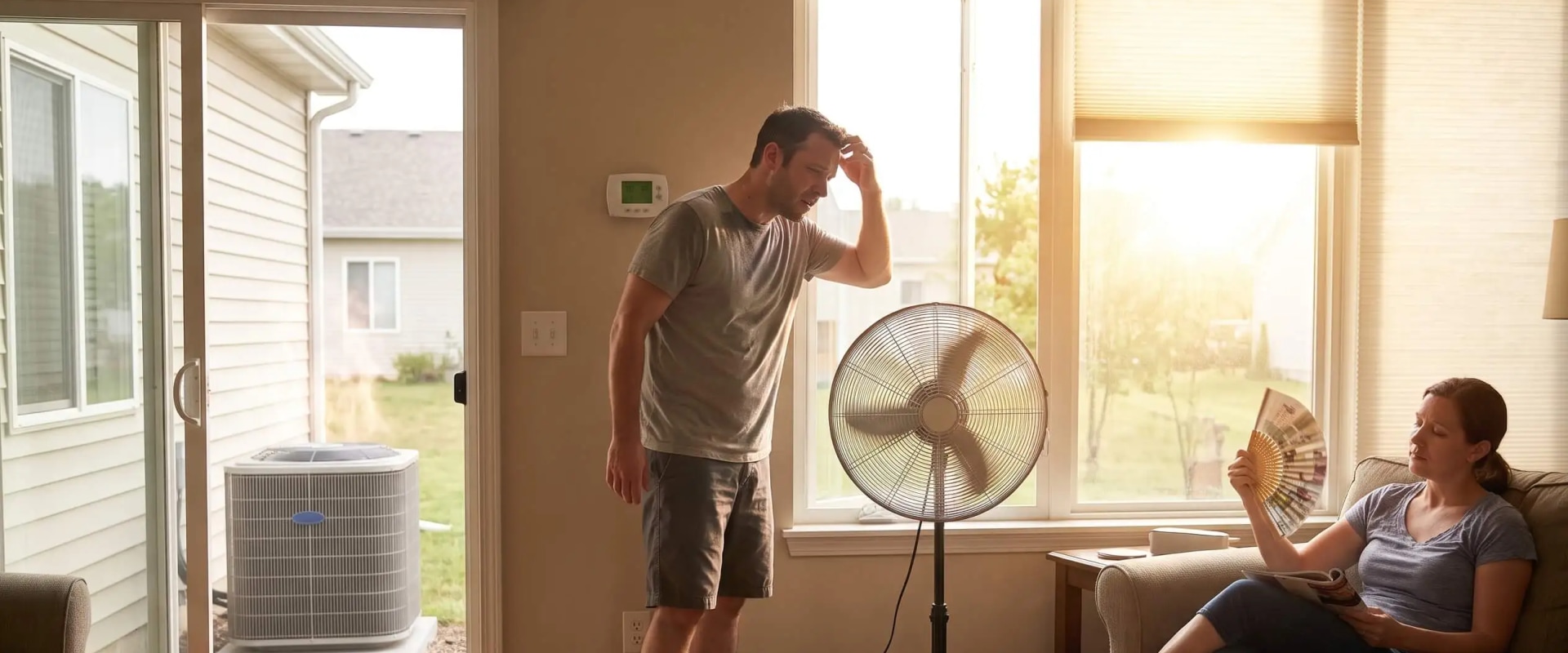
When I work through this problem, the cause almost always lands in one of four spots: the outdoor unit, the thermostat settings, the refrigerant, or hot attic air sneaking into the ductwork.
The checks below for an air conditioner not blowing cold air but running follow the order that finds the answer fastest. Some take five minutes and a garden hose, while others belong to a licensed technician, and I’ll flag which is which as we go.
TL;DR Quick Answers
Air Conditioner Not Blowing Cold Air but Running
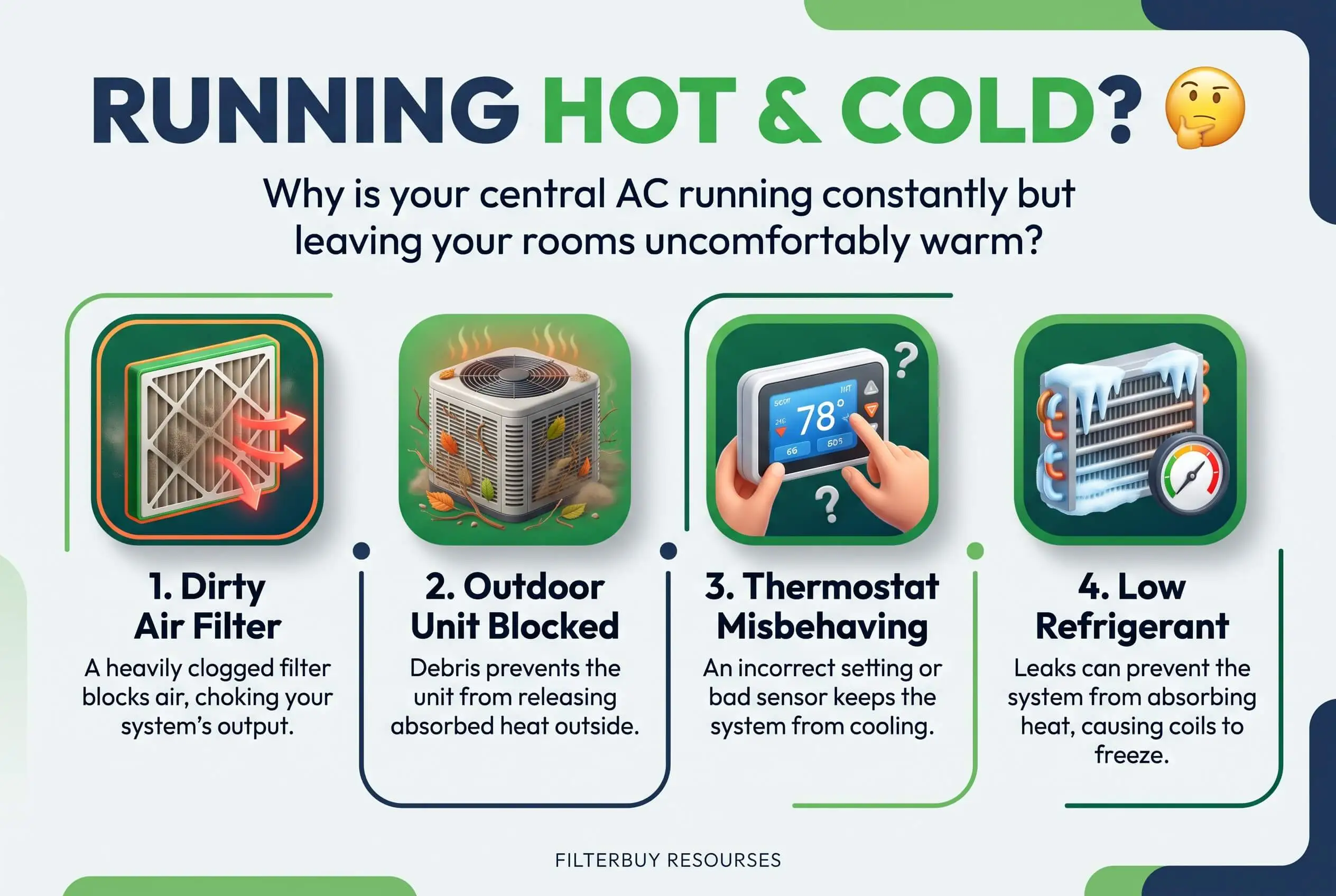
When an air conditioner is running but not blowing cold air, it’s moving air without pulling the heat out. A kitchen thermometer makes that visible, since supply air should run about 15 to 20°F cooler than return air. A smaller drop usually traces back to the outdoor unit, thermostat, coils, refrigerant, or attic ducts.
Outdoor unit silent or humming: Check the breaker and disconnect. A hum with a still fan points to a failed capacitor, which is a pro repair.
Thermostat settings: Mode on Cool, fan on Auto. The On setting blows uncooled air between cycles.
Dirty coils and filter: Rinse the condenser from the inside out and replace a clogged filter.
Low refrigerant: A low charge means a leak, and only an EPA 608 certified technician can repair it.
Leaky attic ducts: Gaps and crushed flex duct dump cooled air and pull hot attic air in.
Ice on the copper line: Turn the system off to protect the compressor.
Top Takeaways
Start at the vent. Strong but warm air means a cooling problem, while weak or missing air means an airflow problem.
Put a number on it. A small temperature drop between the return and supply confirms the system is falling short.
Walk out to the condenser. A silent unit, a hum with a motionless fan, or packed fins explain a big share of warm-air calls.
Rule out the thermostat. Setting the mode to Cool and the fan to Auto fixes more “broken” systems than you’d expect.
Hand refrigerant and electrical work to a pro. Leaks call for an EPA 608 certified technician, and capacitors can hold a charge.
Shut it down if ice forms. A frozen system puts the compressor at risk.
Start at the Vent: Is the Air Moving, and Is It Cold?
Your hand is the first diagnostic tool you own, so hold it over a supply vent before you open a single panel. What you feel there sorts the problem into one of two camps.
Strong airflow that feels lukewarm points to the cooling side of the system, and that’s what the rest of this page covers. Barely any air at all is an airflow problem instead, and this guide on AC running but no air coming from the vents walks through that path step by step.
To put a number on it, run a temperature split test. Let the system run for 15 minutes, then hold a kitchen thermometer at a return grille and again at the supply vent nearest the indoor unit. Healthy systems usually drop the air about 15 to 20°F between those two points. A split under 10°F tells you the system is circulating air without removing much heat.
Check the Outdoor Unit Before Anything Else
Your AC cools the house by pulling heat out of indoor air at the evaporator coil and releasing it outside at the condenser. That’s the short version of how air conditioning moves heat, and it explains why a stalled outdoor unit leaves your indoor fan pushing air that never got cooled.
Head outside while the thermostat is calling for cooling, and listen.
Fan and compressor are both silent. Check the breaker first, then the disconnect box mounted near the unit. With both switched on, a failed contactor or a wiring fault becomes the likely culprit, and that repair belongs to a technician.
The unit hums, but the fan blade won’t turn. That hum is a classic sign of a failed run capacitor. Capacitors can hold a dangerous charge even after the power is off, so this one goes straight to a pro.
Everything runs, but the fins are caked. Grass clippings and cottonwood fluff mat into the fins and trap heat inside the condenser. Kill power at the disconnect, rinse from the inside out with a garden hose, and keep roughly 2 feet of clear space around the unit. Skip the pressure washer, since it bends the fins.
Thermostat Settings That Look Like a Breakdown
Plenty of warm-air complaints start and end at the wall. Make sure the mode reads Cool, not Heat or Fan. Then set the fan to Auto, because on the On setting the blower keeps pushing room-temperature air between cooling cycles, and that feels exactly like a dying system.
While you’re there, swap in fresh batteries and look at where the thermostat hangs. One mounted beside a supply vent or a drafty door reads cooler than the rest of the house, so it shuts the system off before the far bedrooms catch up.
Indoor Causes When Air Flows but Stays Warm
A dirty filter and evaporator coil. A loaded filter chokes airflow across the evaporator coil, and the dust that slips past settles on the coil itself, so it absorbs less heat. During the heavy cooling season, check the filter monthly and use this guide on how often to replace air filters to set a schedule. Most people miss one detail here. A filter rated higher than your system was built to restrict airflow too, so check the owner’s manual before you move up a MERV tier.
Low refrigerant. Your AC doesn’t burn through refrigerant the way a car burns gas, so a low charge means a leak somewhere. Watch for ice on the larger copper line, a faint hiss near the line set, or cooling that fades a little more each week. Federal rules require EPA Section 608 certification to handle refrigerant, which puts this squarely in a technician’s hands.
Leaky ducts in a hot attic. In a lot of homes, supply ducts snake through an attic that can top 120°F in summer. A disconnected joint dumps your cooled air into that attic, while a leak on the return side pulls superheated attic air straight back into the system. When one or two rooms stay warm and the rest feel fine, inspect any joints you can reach for gaps or crushed flex ducts. Seal small gaps with mastic or foil tape. Cloth duct tape won’t hold.
Broken, or Just Outmatched by the Heat?
A warm afternoon doesn’t automatically mean failure. On the hottest days of the year, a correctly sized system can run nonstop and still sit a few degrees above the setpoint until the sun goes down. That’s a system working at its limit.
A broken one behaves differently. Watch for a house that never catches up overnight, or a temperature split that stays low even after the outdoor heat eases, and work back through the checks above if you see either one.
When to Call an HVAC Technician
Call right away if you notice any of these:
A burning or electrical smell
A breaker that trips more than once
Hissing near the refrigerant lines, or ice on the copper line
An outdoor unit that hums while the fan sits still
Book a visit for AC maintenance if the air stays warm after you’ve checked the thermostat, replaced the filter, and rinsed the condenser. And if ice shows up, turn the system off while you wait. Running it frozen strains the compressor, the most expensive part in the whole system to replace.
“In all the warm-air calls I’ve diagnosed, the cause I see missed most is a condenser that looks clean from the yard but is matted deep in the fins, which keeps refrigerant pressure so high that the system runs all afternoon while the supply air drops barely 8 degrees. A careful inside-out rinse each spring often brings that split back to normal before any part needs replacing.”
Essential Resources
EPA: Stationary Refrigeration and Air Conditioning (Section 608) spells out the federal rules for handling refrigerants and how technicians earn certification.
NATE: Why Choose a NATE-Certified Technician explains what certification tells you about the technician you’re letting into your home.
ACCA: Quality Programs points homeowners to contractors accredited for quality installation and service.
FTC: How To Avoid a Home Improvement Scam lists the warning signs worth knowing before you hire anyone.
Heat.gov: Heat Safety covers how to keep your household safe at home when cooling fails during a heat wave.
National Weather Service: Heat Safety Tips and Resources names the people most at risk as indoor temperatures climb, so you know who to check on first.
Ready.gov: Extreme Heat suggests ways to prepare for hot days, from attic ventilation to weather-stripping.
Supporting Statistics
About 20 to 30 percent of the air moving through a typical home’s ducts never reaches a room. ENERGY STAR traces that loss to leaks, holes, and poorly connected ducts, and it leaves rooms hard to cool no matter where you set the thermostat. (ENERGY STAR)
Swapping a dirty filter for a clean one can cut AC energy use by 5% to 15%. A clogged filter restricts airflow and lets dirt reach the evaporator coil, where it insulates the coil and weakens its ability to absorb heat. (U.S. Department of Energy)
96% of Florida households use air conditioning, and 90% rely on central AC. Nationwide, 88% of U.S. households used air conditioning in the 2020 Residential Energy Consumption Survey. (U.S. Energy Information Administration)
Leaky ducts can waste 20% to 30% of conditioned air, while replacing dirty filters can reduce AC energy use by 5% to 15%. Regular filter changes, including properly sized MERV 8 pleated furnace air filters, can help maintain airflow and improve cooling efficiency, especially in homes that rely heavily on central air conditioning.
Final Thoughts and Opinion
A running AC that won’t cool the rooms feels like a mystery, yet it usually points straight at its own cause. Strong, warm airflow sends you to the outdoor unit, the thermostat, the refrigerant, or the ducts. Give it ten minutes with a thermometer and a walk around the condenser, and you’ll have narrowed things down before anyone opens a panel.
In my opinion, most homeowners wait too long on the easy checks and move too fast on the hard ones. Rinsing a condenser or flipping a fan setting costs nothing, while topping off refrigerant without finding the leak just pushes a bigger bill down the road.
Preventing a repeat comes down to habit. Change the filter on schedule and rinse the condenser every spring. Keeping attic ductwork sealed matters just as much, because it protects both your energy bill and the compressor doing the heaviest lifting in your home.
Frequently Asked Questions
Why is my AC running but the house is not cooling down?
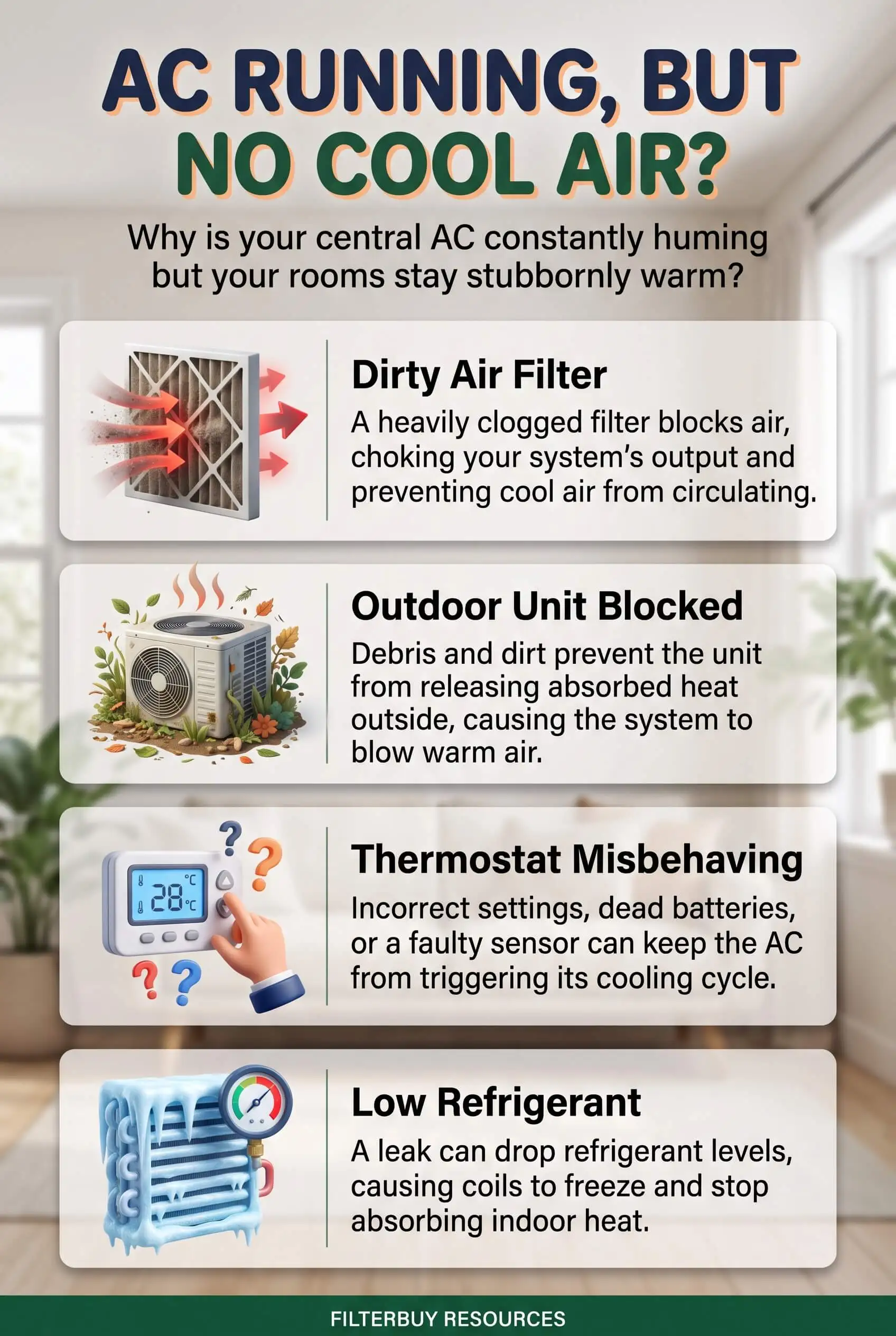
In most homes, the culprit is one of five things: a stalled outdoor unit, a thermostat fan set to On, a dirty condenser or evaporator coil, low refrigerant from a leak, or leaky ducts in a hot attic. Check the vent temperature and the outdoor unit first. Those two checks rule out most of the list in minutes.
Why is my outside AC unit not running but the inside fan is?
Your indoor blower and outdoor unit run on separate parts, so one can keep going while the other sits idle. Start with the breaker and the outdoor disconnect. If both are on, you’re likely looking at a failed contactor, a bad capacitor, or a wiring fault, and those repairs belong to a licensed technician.
Can a dirty filter make my AC blow warm air?
Yes. A clogged filter starves the evaporator coil of airflow and lets dust coat its surface, so the coil absorbs less heat and, in severe cases, freezes. Replace the filter, then give the system some time to recover before you judge the result.
How long should my AC take to cool the house?
That depends on your home’s size, its insulation, the heat outside, and whether you’ve chosen the right air conditioning brand for your cooling needs. On a mild day, a healthy system should make steady progress within an hour. On the hottest afternoons it may run nonstop and still trail the setpoint, which is normal as long as it catches up overnight.
Is it safe to keep running an AC that is not cooling?
For a short stretch while you troubleshoot, usually yes. Shut it off if you spot ice on the lines, smell something burning, or hear the outdoor unit humming while the fan stays still, because running through any of those strains the compressor.
Get Every Room Cooling Again
A central AC that runs without cooling the rooms usually reveals its cause at the vent, the thermostat, or the outdoor unit, so start your search there. For anything involving refrigerant or electrical parts, bring in a certified technician who can get your whole home comfortable again and maintain an energy efficient home.


