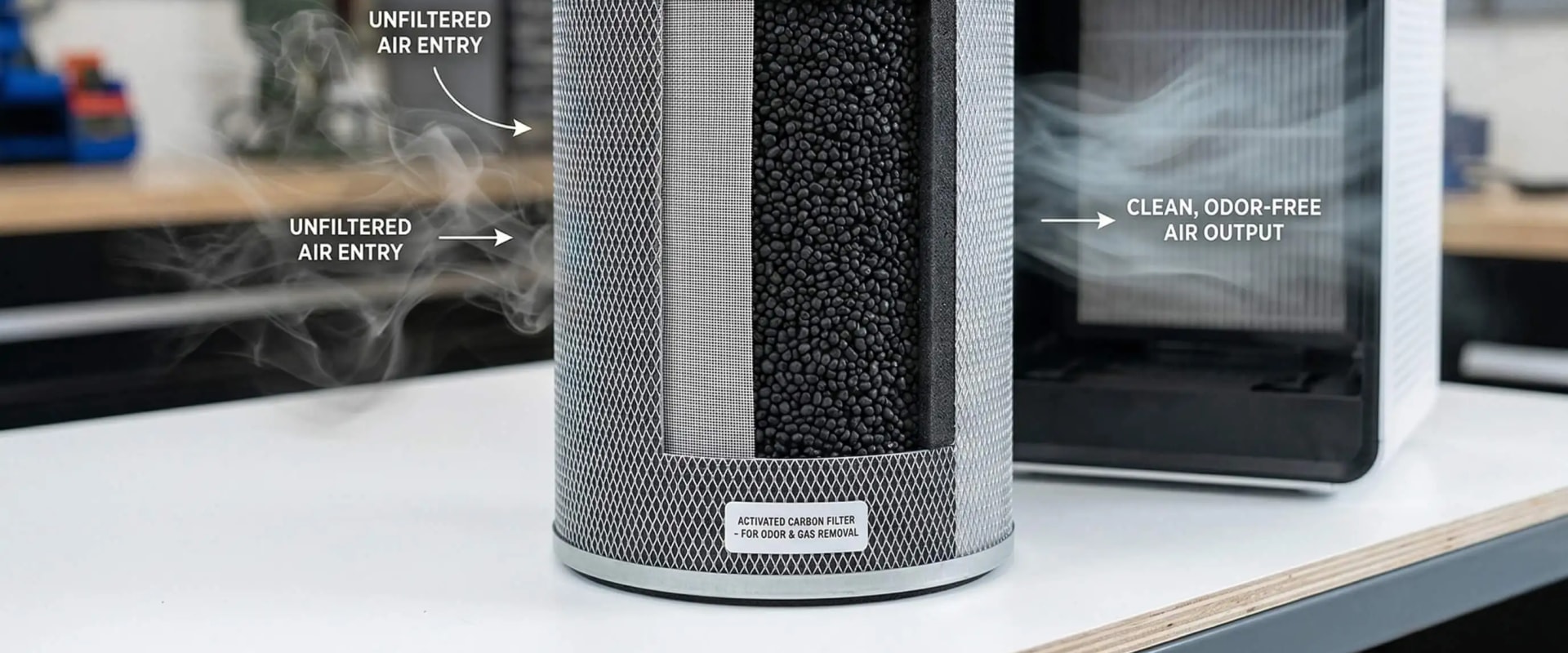
Here is the short answer: carbon filter work through a process called adsorption, which traps gases and volatile organic compounds (VOCs) at the molecular level. Pollen and dust are physical particles, not gases — and that distinction changes everything about how they need to be filtered.
This page breaks down exactly what carbon filters do and do not capture, how they compare to MERV-rated mechanical filters for allergen control, and how to choose the right filter — or the right combination — based on what is actually floating through your home's air.
TL;DR Quick Answers
carbon filter
A carbon filter uses activated carbon to capture odors, VOCs, and chemical vapors through adsorption. It does not capture allergens like pollen or dust — those require a MERV-rated mechanical filter. Key facts:
Carbon filters solve what you smell — not what you breathe in
Effective against: odors, smoke, VOCs, and chemical vapors
Not effective against: pollen, dust, mold spores, and pet dander
Best replacement window: every 90 days under normal household conditions
Best for allergy sufferers: MERV 11 or MERV 13 mechanical filter
Best for odors and allergens combined: a dual-action carbon and MERV filter
Filterbuy's Odor Eliminator combines activated carbon with MERV 10-equivalent filtration in a single filter
Carbon and MERV-rated filtration are complementary technologies — not competing ones. After manufacturing air filters for over a decade and serving more than two million households, the most important thing we can tell you is this: match the filter to the threat. Odors and vapors point to carbon. Pollen and dust point to MERV. Both threats point to a dual-action solution.
Top Takeaways
Carbon filters target gases — not particles. Activated carbon captures VOCs, odors, and chemical vapors. It cannot intercept pollen or dust.
MERV-rated filters are the real allergen solution. MERV 11 is the threshold where allergy relief becomes meaningful. MERV 13 is the strongest residential option available.
Carbon and MERV filtration are complementary — not interchangeable. Chemical vapors and airborne particles are separate threats. Neither filter type replaces the other.
Indoor air is more polluted than most homeowners realize. Americans spend 90% of their time indoors. Pollutant concentrations regularly run 2 to 5 times higher than outdoors.
Ask the right question before choosing a filter. Odors and chemical vapors point to carbon. Pollen, dust, and dander point to MERV. Both threats point to a dual-action solution.
How Carbon Filters Actually Work
Carbon filters — also called activated carbon or charcoal filters — use a process called adsorption to capture contaminants. As air passes through the filter media, gases and chemical compounds bond to the surface of the activated carbon material at the molecular level. It is an impressive mechanism for what it is designed to do.
In our manufacturing experience, the key word is "gases." Activated carbon is highly effective at capturing:
Volatile organic compounds (VOCs) from cleaning products, paints, and adhesives
Household odors from cooking, pets, and smoke
Chemical vapors and fumes
Some gaseous byproducts of combustion
What Carbon Filters Cannot Capture
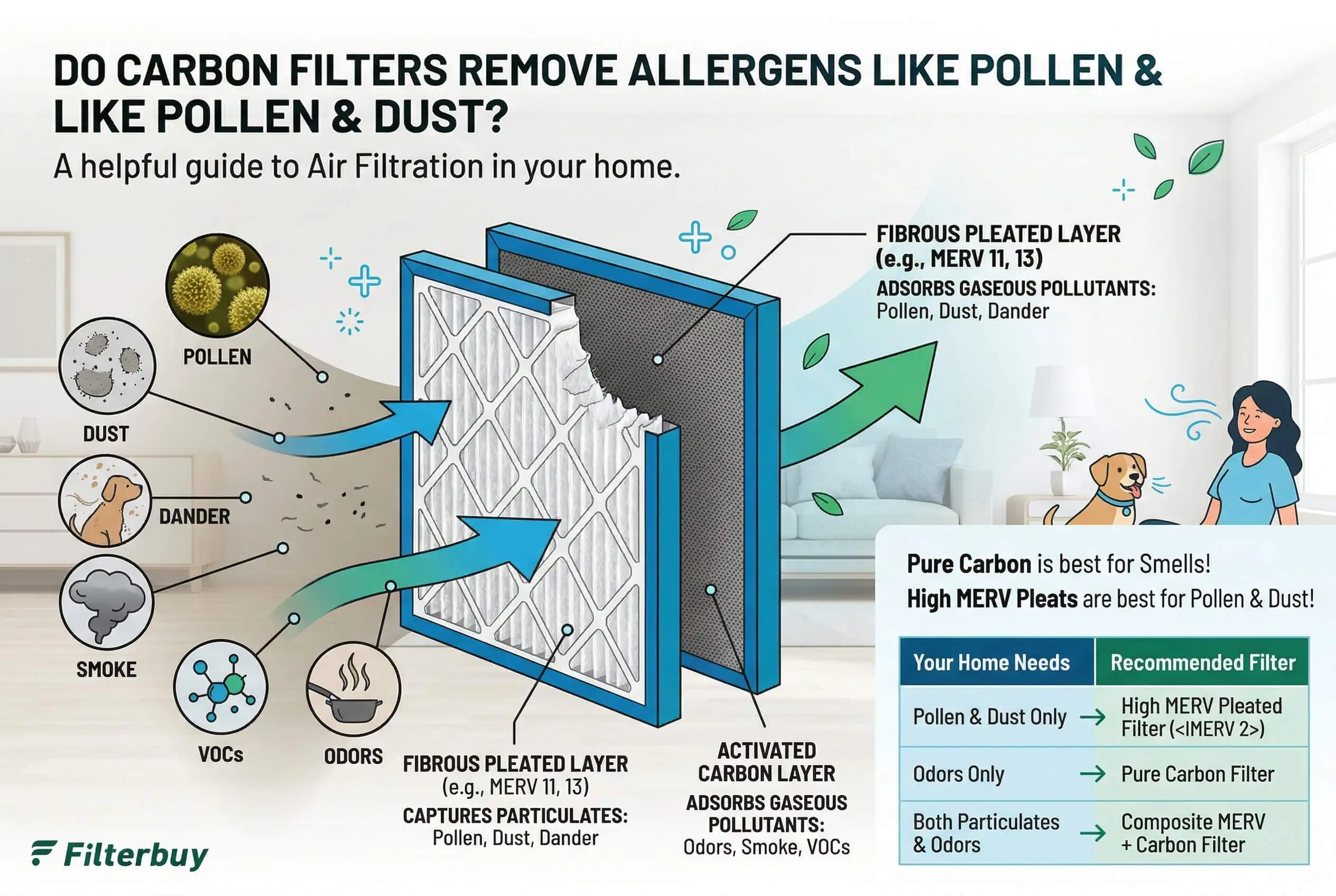
Pollen and dust are physical particles — not gases. They do not bond to activated carbon the same way chemical vapors do. A standard carbon filter simply lacks the dense mechanical filtration media needed to intercept and hold airborne particulates at the size range that triggers allergy symptoms.
Through years of working directly with allergy-sensitive households, we have seen what happens when homeowners rely solely on carbon filters for allergen control: the odors improve, but the sneezing does not stop.
How MERV-Rated Filters Address Allergens
Mechanical air filters rated on the MERV scale (Minimum Efficiency Reporting Value) are specifically engineered to capture airborne particles — including the ones that make allergy sufferers miserable. Here is how MERV ratings map to common allergens:
MERV 8: Captures dust, pollen, and larger particles — a solid baseline for most homes
MERV 11: Captures finer dust, mold spores, and pet dander — recommended for households with allergy sufferers
MERV 13: Captures microscopic particles including bacteria and fine respiratory droplets — the strongest residential option we manufacture
For allergy relief, MERV 11 is the threshold where we consistently see meaningful results across the households we serve.
When Carbon and MERV Filtration Work Together
The most complete indoor air quality solution addresses both categories of airborne threats: particles and gases. Filterbuy's Odor Eliminator filters combine activated carbon with a MERV-rated mechanical filtration layer — delivering allergen capture alongside odor and chemical vapor control in a single filter.
This dual-action approach is especially valuable in homes where allergy sufferers also contend with:
Pet odors alongside pet dander
Wildfire smoke seasons that bring both particles and chemical byproducts
VOC exposure from new flooring, cabinetry, or renovation projects
Which Filter Is Right for Your Home?
Choosing the right filter depends on your household's specific air quality challenges:
Odors only: A standalone activated carbon filter addresses the source
Allergens only: A MERV 11 or MERV 13 mechanical filter is the right tool
Both odors and allergens: A combination carbon + MERV filter delivers complete protection
Year-round allergy sufferers or households with respiratory sensitivities: MERV 13 with carbon is the standard we recommend from experience
Clean air is rarely a single-filter problem. Understanding what each filter type is engineered to do — and what it is not — is the foundation of a home that actually breathes better.
"Most homeowners come to us believing a better filter means one filter that does everything — and we understand why. The marketing around air filtration makes it easy to assume that. What we have learned after manufacturing filters for over a decade and working with millions of households is that carbon and mechanical filtration solve fundamentally different problems. Carbon targets what you smell. MERV targets what you breathe in. When allergy season hits and someone is still suffering despite running a carbon filter, nine times out of ten the filter is doing exactly what it was built to do — it just was not built for pollen and dust. Matching the right filter to the right threat is the single most overlooked step in protecting your family's air, and it is the conversation we wish more homeowners were having before allergy season starts."
Essential Resources
After more than a decade of manufacturing carbon filters and fielding questions from over two million households, we know this topic generates more confusion than almost any other in home air quality. These resources are the ones we point homeowners to first — sourced exclusively from government and leading health organizations — because getting this decision right matters for your family's health.
1. What the EPA Wants Every Homeowner to Know About Air Cleaner Selection The EPA's consumer guide is the clearest official breakdown of how different filter types — carbon versus mechanical — address fundamentally different categories of indoor air pollutants. If you want to understand the "why" behind filter selection from the most authoritative source available, start here. https://www.epa.gov/indoor-air-quality-iaq/guide-air-cleaners-home
2. The Technical Research Behind Residential Filtration Performance This is the longer-form EPA resource our team references when customers ask us about filter efficiency data. It covers MERV rating science, gas-phase filtration research, and the real-world evidence behind what carbon and mechanical filters each accomplish — and where each one falls short. https://www.epa.gov/indoor-air-quality-iaq/air-cleaners-and-air-filters-home
3. Why VOCs in Your Home Demand a Different Filter Than Allergens Do In our experience, most homeowners do not realize that indoor VOC concentrations can run significantly higher than outdoor levels. The EPA's VOC resource explains exactly what activated carbon is designed to capture, why those chemical threats are invisible, and what the health stakes are when they go unaddressed. https://www.epa.gov/indoor-air-quality-iaq/volatile-organic-compounds-impact-indoor-air-quality
4. The Complete Indoor Air Threat Map — Because Clean Air Has More Than One Enemy One of the most important things we have learned serving millions of households is that indoor air is rarely threatened by just one type of pollutant. The EPA's indoor air quality hub maps the full range of airborne threats — particles, gases, biological contaminants — and the filtration strategies proven to address each category. https://www.epa.gov/air-quality/indoor-air-quality
5. How the Nation's Leading Allergy Organization Recommends Filtering Allergens The Asthma and Allergy Foundation of America is direct about something we reinforce from our own manufacturing experience: allergen control requires the right filter, not just any filter. This resource outlines how pollen, dust, and pet dander move through your home — and which filter certifications are clinically proven to intercept them. https://aafa.org/allergies/prevent-allergies/control-indoor-allergens/
6. Understanding Pollen as a Physical Particle — Not a Gas The American Academy of Allergy, Asthma & Immunology explains how pollen is scientifically classified and measured as a physical airborne particle. This distinction is the core reason mechanical MERV-rated filtration — not carbon adsorption — is the correct tool for seasonal allergy relief in your home. https://www.aaaai.org/tools-for-the-public/allergy,-asthma-immunology-glossary/pollen-counts-defined
7. When Wildfire Smoke Forces Both Problems Into Your Home at Once Wildfire season is the clearest real-world example of why a single filter type is rarely enough. This joint EPA and AirNow fact sheet explains how MERV-rated mechanical filters perform against smoke-driven particulates — and why homes in smoke-affected regions need both carbon and particle filtration working together to provide complete protection. https://www.airnow.gov/sites/default/files/2020-10/indoor-air-filtration-factsheet_1.pdf
Supporting Statistics
Numbers rarely lie — but they do get ignored without context. After more than a decade on the manufacturing side of home air filtration, here is what these statistics actually mean for the air your family breathes every day.
Statistic 1: Americans spend approximately 90% of their time indoors — where pollutant concentrations are often 2 to 5 times higher than outdoor levels.
Most homeowners think about air quality the way they think about weather — something that happens outside. Our manufacturing experience tells a different story:
Your home is not a refuge from air pollution — for many households, it is the primary source
The wrong filter leaves your family continuously exposed in the environment where they spend nearly all of their time
Filter selection is not about supplementing outdoor air — it is about managing a self-contained indoor environment
Source: U.S. Environmental Protection Agency — Indoor Air Quality Report on the Environment https://www.epa.gov/report-environment/indoor-air-quality
Statistic 2: Indoor VOC concentrations can run up to 10 times higher than outdoor levels — making activated carbon the only residential filtration mechanism built to address them.
This is the statistic that reframes the entire carbon filter conversation. When customers tell us their carbon filter has not helped their allergies, this number explains exactly why — and why carbon filtration still matters as part of a complete indoor air strategy:
Cleaning products, adhesives, new furnishings, and paints quietly off-gas VOCs at concentrations that dwarf outdoor pollution levels
Carbon filtration does not compete with mechanical allergen capture — it addresses a completely separate category of threat
A MERV-rated filter cannot touch chemical vapors — and a carbon filter cannot capture pollen or dust particles
Source: U.S. Environmental Protection Agency — Volatile Organic Compounds' Impact on Indoor Air Quality https://www.epa.gov/indoor-air-quality-iaq/volatile-organic-compounds-impact-indoor-air-quality
Statistic 3: Nearly 1 in 3 U.S. adults — approximately 25.7% — carry a diagnosed seasonal allergy, according to CDC National Health Interview Survey data.
Across more than two million households served, allergy sufferers are among our most consistently underserved customers — not because good solutions do not exist, but because filter selection routinely steers them in the wrong direction. What this statistic means in practice:
1 in 3 adults makes indoor allergen control a household health priority, not a home maintenance task
Pollen and dust are daily physiological triggers for a quarter of the adult population
Mechanical MERV-rated interception — not carbon adsorption — is the only filtration mechanism that meaningfully reduces them in the home environment
Source: Centers for Disease Control and Prevention — Diagnosed Allergic Conditions in Adults: United States, 2021 https://www.cdc.gov/nchs/products/databriefs/db460.htm
These statistics show that indoor air quality is a daily health issue shaped by pollutant buildup, VOC exposure, and widespread allergy triggers — which is why choosing the right air conditioning for home matters as part of a broader strategy for cleaner airflow, better filtration, and healthier indoor living.
Final Thoughts
Carbon filters are genuinely impressive technology — and genuinely misunderstood ones. After manufacturing air filtration products for over a decade and working directly with more than two million households, our perspective is shaped less by product specs and more by what we have seen play out in real homes.
Here is the opinion we have formed from that experience: the carbon filter confusion is not a consumer problem. It is an industry communication problem.
The filtration category has done a poor job of explaining what different filter types are engineered to do. Marketing language leans on broad terms like "cleaner air" without drawing the line between gaseous threats and particulate threats — a distinction that determines whether a filter actually helps an allergy sufferer or simply makes the kitchen smell better.
What we know to be true from the manufacturing side:
Carbon and MERV-rated mechanical filtration are not competing technologies — they are complementary ones
Homes with both odor sources and allergy sufferers are not edge cases — they are the majority of American households
The most effective indoor air strategies treat chemical vapors and airborne particles as separate problems requiring separate — or combined — solutions
Upgrading to a dual-action filter is one of the highest-impact, lowest-effort changes a homeowner can make
Our honest assessment, based on what we see across millions of households:
Allergy sufferer using a carbon-only filter: your air probably smells fine — and your symptoms are probably not improving
Using a mechanical filter without carbon: you are managing particles but ignoring the chemical vapor load building in your indoor air
Using both: you are treating your home's air the way it actually deserves to be treated
Clean air is not a single-filter problem, and it never has been. The homeowners who breathe the best air stop asking "which filter is best" and start asking "which threats am I actually dealing with." That is the question we have built our product line around — and the one every homeowner deserves a straight answer to.

FAQ on Carbon Filters
Q: What does a carbon filter actually do? A: Carbon filters capture gases, odors, and VOCs through adsorption. Chemical compounds bond to activated carbon media at the molecular level. After manufacturing these filters for over a decade, the clearest way we explain it:
Carbon filters solve what you smell — not what you breathe in
Effective against: cooking odors, pet smells, smoke, and chemical vapors from cleaning products and adhesives
Not effective against: pollen, dust, and pet dander
Q: Will a carbon filter help with my allergies? A: Not on its own. This is the misconception we encounter most consistently across the millions of households we serve. Here is why:
Allergens are physical particles — not gases
Carbon adsorption is not the mechanism required to intercept them
For meaningful allergy relief, MERV 11 is the threshold we recommend from experience
MERV 13 is recommended for households with heightened respiratory sensitivities
For homes with both odors and allergens — which is most homes — a dual-action carbon and MERV combination filter is the most practical solution
Q: What is the difference between a carbon filter and a MERV-rated filter? A: They solve different problems entirely. One of the most important things our manufacturing experience has taught us: these technologies are complementary, not interchangeable.
Carbon filters address: odors, VOCs, and chemical vapors
MERV-rated filters address: pollen, dust, mold spores, pet dander, and bacteria
Homes that treat them as competing options consistently end up with gaps in their indoor air protection
Q: How long does a carbon filter last? A: Under normal household conditions, 90 days is the standard replacement window we stand behind. Key factors that affect carbon filter lifespan:
Multiple pets or high pet activity
Frequent cooking or strong cooking odors
Ongoing renovation or construction work
High VOC output from cleaning products or new furnishings
Once carbon media reaches capacity, odor and VOC capture drops off — often with no visible sign the filter is spent
Consistent replacement is the single most important factor in maintaining performance
Q: Can I use a carbon filter and a MERV filter at the same time? A: Yes — and for most households dealing with both odors and allergens, it is the approach we recommend without hesitation. Here is what a dual-action solution looks like in practice:
Filterbuy's Odor Eliminator filters combine activated carbon with MERV 10-equivalent mechanical filtration in a single filter
Both threat categories — gases and particles — are addressed in one replacement cycle
No guesswork managing two separate filter types
In our experience, this is the most complete residential filtration solution available without investing in a whole-home air purification system
Ready to Find the Right Filter for Allergens, Odors, or Both?
Now that you know carbon filters and MERV-rated mechanical filters solve different problems, finding the right protection for your home starts with knowing which threats you are actually dealing with. Shop Filterbuy's full filter lineup — including our dual-action Odor Eliminator — and get American-made filtration that is guaranteed to fit, built to perform, and delivered directly to your door.