What cleaning can address is surface-level dust buildup on an otherwise functional unit. The difference matters, and misreading it costs homeowners time and money. This page shows you exactly how to tell the two situations apart, which symptoms point to replacement, and how to make the most cost-effective call for your heating system.
TL;DR Quick Answers
electric furnace
An electric furnace is a central heating system that warms air using electric heating elements and pushes that warm air through your home's ductwork via a blower motor. Unlike gas furnaces, electric furnaces have no combustion, no flue, and no risk of carbon monoxide — making them one of the simplest and safest residential heating systems available.
Here is what every electric furnace owner should know:
Electric furnaces operate at a minimum AFUE of 98.3% — meaning nearly all incoming electricity converts directly into heat
Most residential electric furnaces contain two to four sequencers that stage heating element activation to prevent electrical overload
Heating elements, sequencers, blower motors, and safety limit switches are the primary components most likely to require attention over the system's lifespan
The typical service life of a residential electric furnace is 15 to 20 years with proper maintenance
A clean, correctly sized filter is essential — it protects the blower, supports airflow across the heating elements, and directly affects the quality of air circulating through your home
After manufacturing air filtration products for over a decade and serving over two million households, we've found that electric furnace problems are almost always caught too late. The system runs quietly, fails quietly, and rewards the homeowner who checks before there's a reason to.
Top Takeaways
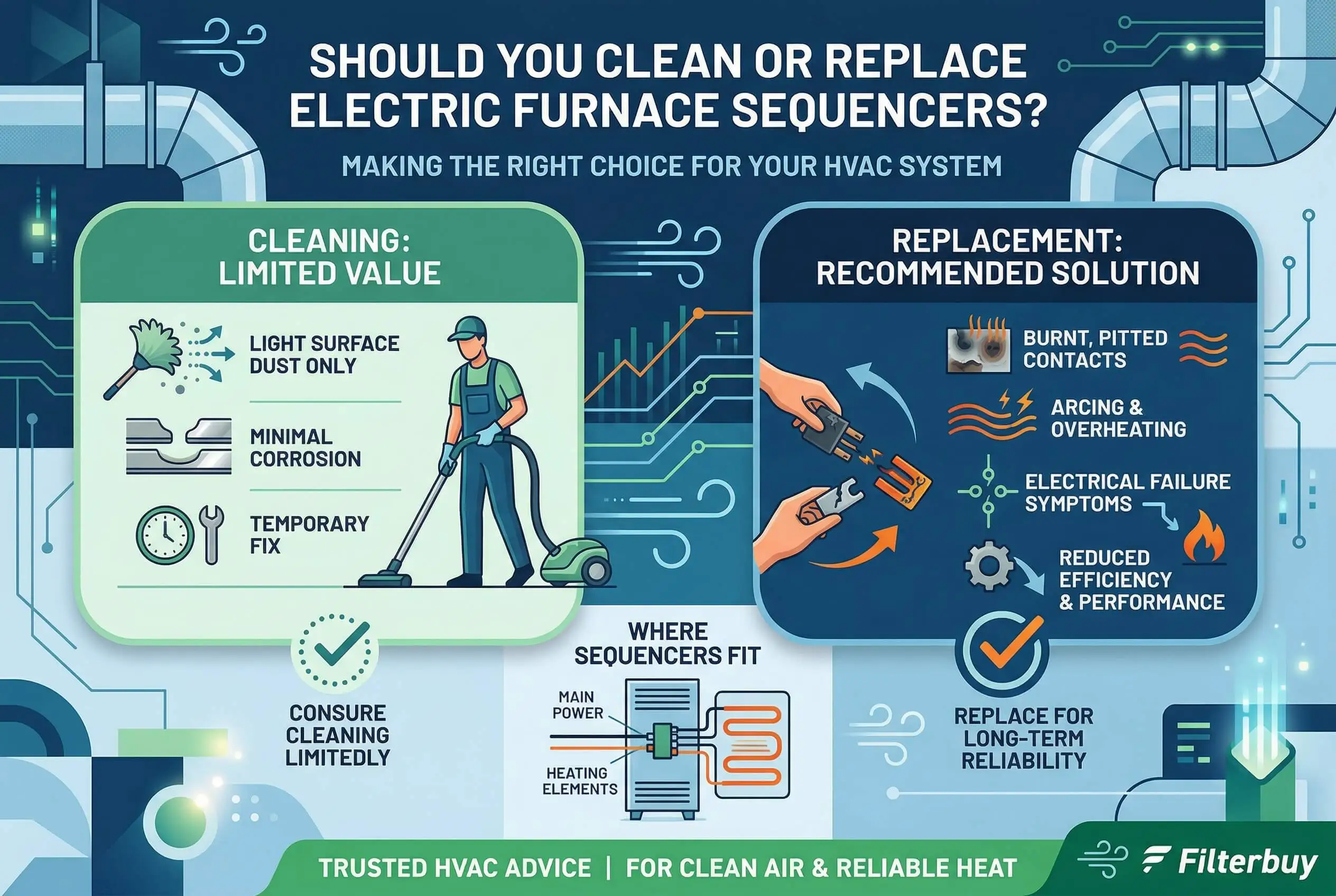
Replace before you clean. A faulty sequencer should be replaced in most cases — not cleaned. Sequencers degrade from the inside out. By the time symptoms appear, internal contacts or bimetal strips have already begun to fail. Cleaning cannot reverse that.
Know when cleaning makes sense. Cleaning is only worth attempting when all three conditions are met:
The unit is relatively new
The issue is clearly external — visible dust or debris on the contacts
No electrical symptoms are present
A failing sequencer costs more than its replacement price. When sequencers stage elements incorrectly, the downstream effects add up quickly:
Heating elements run harder to compensate
Energy draw climbs without a corresponding increase in heat output
Filter runtime drops and indoor air quality declines
A $10 to $30 fix left unaddressed becomes a heating element replacement conversation
Your sequencer and your filter are connected problems. A sequencer failure reduces system runtime and airflow. Less runtime means your filter captures less and airborne particles circulate longer. The EPA confirms Americans spend approximately 90% of their time indoors — where pollutant concentrations are often 2 to 5 times higher than outdoors. Sequencer maintenance is also an air quality decision.
Test before you replace it if you have any doubt. A basic continuity test with a multimeter confirms failure. Here's how:
Power down the furnace and disconnect the sequencer's wiring
Apply a small test voltage to the heater terminals
Wait 30 to 60 seconds for the bimetal strip to warm
Check for continuity across the switching contacts
No continuity confirms the sequencer has failed and should be replaced
What Does an Electric Furnace Sequencer Actually Do?
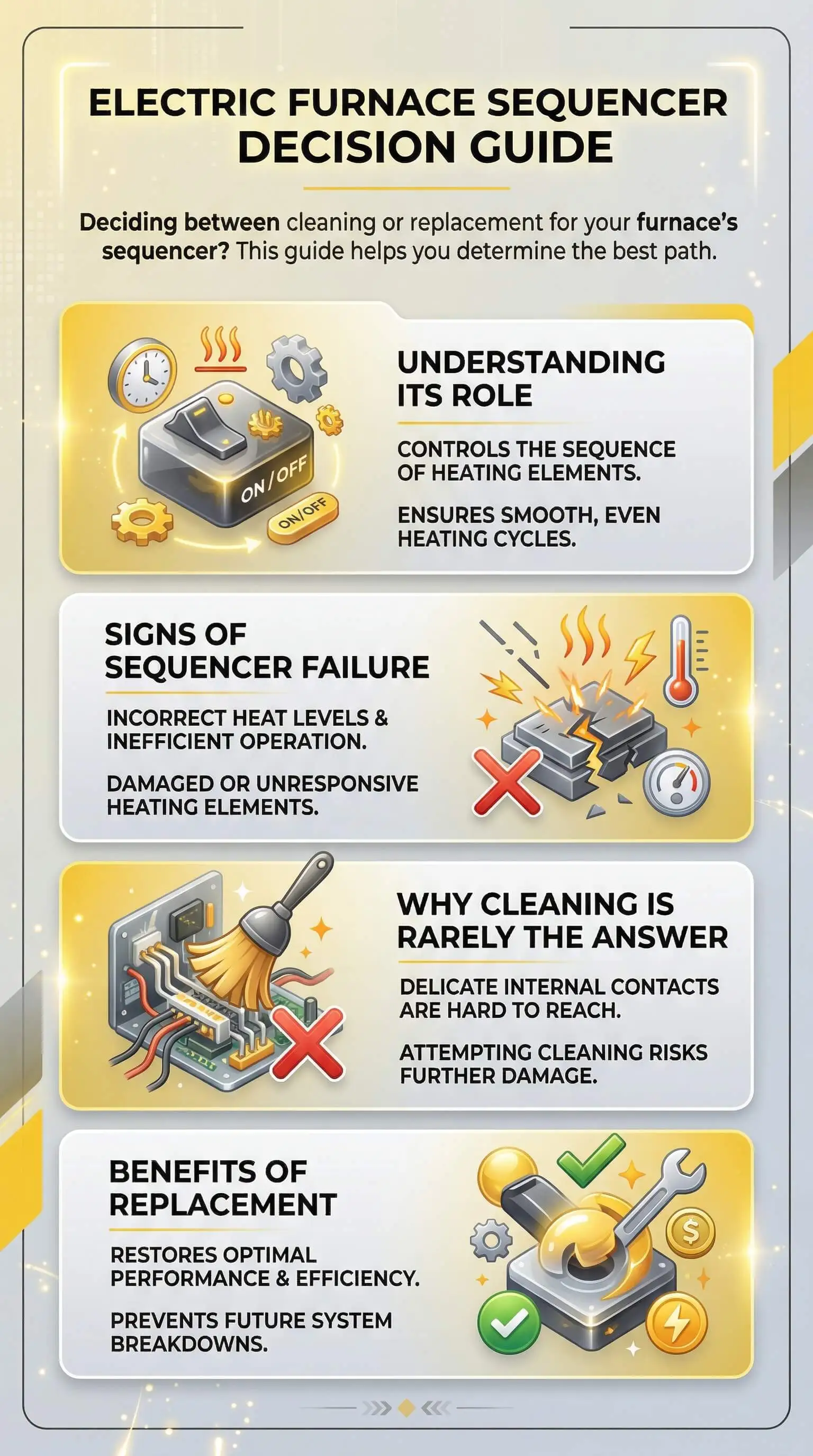
An electric furnace sequencer is a small relay component that staggers the startup of your furnace's heating elements. Instead of all elements switching on simultaneously — which would spike your electrical load and trip breakers — the sequencer activates them in sequence, a few seconds apart.
Most electric furnaces contain two to four sequencers, each controlling one or more heating elements—an important detail to understand when choosing the right air conditioning brand for home. When even one fails, your furnace either underperforms or stops heating altogether.
Why Sequencers Fail
Sequencers fail for predictable reasons. In our experience servicing electric heating systems across multiple climates, the most common causes are:
Worn bimetal strips that no longer flex reliably under heat
Burnt or pitted electrical contacts caused by repeated switching cycles over years of use
Voltage irregularities that accelerate contact wear
Age — most sequencers have a practical service life of 10 to 15 years
Surface dust and debris can accumulate on the unit and occasionally interfere with contact closure, but internal wear is far more common and far more consequential.
Signs Your Sequencer Needs Replacement
These symptoms indicate a failing sequencer that cleaning will not fix:
Furnace runs but produces little or no heat
Only some rooms heat while others stay cold
Furnace cycles on and off without reaching the set temperature
Heating elements activate inconsistently from one cycle to the next
Breakers trip when the furnace starts
If you're experiencing any combination of these, the sequencer's internal components have most likely degraded beyond what maintenance can restore.
When Cleaning Might Help
Cleaning is worth attempting only when the sequencer is relatively new and the issue is clearly external. Signs that cleaning may be the appropriate first step:
The unit is less than three to five years old
Visible dust or debris is blocking the contact points
The furnace recently passed through an unusually dusty environment, such as a renovation or construction period
No electrical symptoms are present — only sluggish response times
Even in these cases, cleaning should be considered a diagnostic step, not a guaranteed fix.
How to Test a Sequencer Before Replacing It
A basic continuity test with a multimeter will tell you whether a sequencer's contacts are functioning. With the furnace powered down:
Disconnect the sequencer's wiring connections
Set your multimeter to continuity or resistance mode
Apply a small test voltage to the heater terminals and wait 30 to 60 seconds for the bimetal strip to warm
Check for continuity across the switching contacts
No continuity after the warm-up period confirms the sequencer has failed and should be replaced. This is a straightforward test, but if you're not comfortable working inside an electrical panel or with live components, a licensed technician should perform the diagnostic.
The Cost Case for Replacement
Sequencers typically cost between $10 and $30 per unit, making them one of the most affordable components in an electric furnace. Labor for a professional replacement generally runs $75 to $150 depending on your market. Given that cost, most homeowners are better served by replacing a suspect sequencer outright than spending time on cleaning that may only delay the inevitable by a few weeks or months.
The calculus changes only if your furnace is nearing the end of its service life — typically 15 to 20 years for electric models. In that case, furnace filter replacement and a broader system evaluation make more sense before investing in any component-level repairs.
"Most homeowners assume a sequencer problem means something major has gone wrong with their furnace. In our experience, it's usually the opposite — sequencers are small, inexpensive components that wear out quietly over time, and the symptoms they cause can look far more alarming than the repair actually is. After working with electric heating systems across multiple climates and serving over two million households, we've seen the same pattern repeat: the homeowners who fare best are the ones who test first and replace quickly, rather than waiting to see if the problem resolves on its own. A $20 sequencer left unaddressed long enough can put real strain on your heating elements — and those are not inexpensive to replace."
Essential Resources
After manufacturing air filtration products for over a decade and serving more than two million households, we know that a well-informed homeowner makes better decisions — faster. These resources come from government sources we trust. They cover everything from how your electric furnace works to what it costs to run, how to keep it safe, and how the air moving through it affects your family.
Furnaces and Boilers | U.S. Department of Energy The clearest government overview of how electric furnaces work, how efficiency is measured, and when repair costs no longer make sense compared to replacement. Start here if you are still getting familiar with the basics. https://www.energy.gov/energysaver/furnaces-and-boilers
Furnaces Key Product Criteria | ENERGY STAR If you are weighing whether to repair your current system or upgrade, this resource explains the efficiency benchmarks — including AFUE and ECM motor standards — that certified replacement units must meet. A useful reference before any major purchase decision. https://www.energystar.gov/products/furnaces/key_product_criteria
Inspect Home Furnace System for Hazards, Carbon Monoxide | U.S. Consumer Product Safety Commission The CPSC recommends a professional inspection of your furnace's electrical and mechanical components every year. This resource explains exactly what that inspection should cover — including the thermostat controls and automatic safety switches that work alongside your sequencer. https://www.cpsc.gov/Newsroom/News-Releases/1991/Inspect-Home-Furnace-System-For-Hazards-Carbon-Monoxide
Keep Warm and Safe This Winter | U.S. Consumer Product Safety Commission Current CPSC safety guidance on home heating equipment. Covers fire risks, what professional furnace inspections should include, and why ignoring small problems in your heating system tends to create bigger ones. https://www.cpsc.gov/Newsroom/News-Releases/2026/Keep-Warm-and-Safe-This-Winter-Tips-for-Using-Generators-Furnaces-and-Space-Heaters
Guide to Air Cleaners in the Home | U.S. Environmental Protection Agency Your electric furnace moves a lot of air through your home — and the filter it runs through matters. This EPA guide explains how furnace and HVAC filters affect indoor air quality, how to choose the right filtration level, and how often filters should be replaced. https://www.epa.gov/indoor-air-quality-iaq/guide-air-cleaners-home
Improving Indoor Air Quality | U.S. Environmental Protection Agency When your furnace underperforms — as it does when a sequencer fails — airflow drops and indoor air quality follows. This resource connects HVAC system performance directly to household health, and explains how filtration and ventilation work together. https://www.epa.gov/indoor-air-quality-iaq/improving-indoor-air-quality
Energy Conservation Standards for Oil, Electric, and Weatherized Gas Consumer Furnaces | Federal Register The DOE has confirmed that electric furnaces already operate near 100% AFUE efficiency at the point of use. This official rulemaking document is the primary source for that finding — and useful context if you are evaluating whether your aging system is worth keeping long-term. https://www.federalregister.gov/documents/2024/10/18/2024-23906/energy-conservation-program-energy-conservation-standards-for-oil-electric-and-weatherized-gas
Supporting Statistics
Numbers confirm what we've seen repeatedly while serving over two million households. The data below explains why electric furnace maintenance decisions matter — and why a component as small as a sequencer carries consequences well beyond the furnace cabinet.
42% of U.S. households now rely on electricity as their primary space heating fuel. Source: U.S. Energy Information Administration, Residential Energy Consumption Survey (RECS), 2024 https://www.eia.gov/todayinenergy/detail.php?id=66324
That share has grown steadily as Americans relocate to warmer climates and natural gas restrictions expand. In our experience, that shift has also changed how homeowners approach HVAC maintenance. Electric systems have no pilot lights, no flue gases, and no combustion to inspect — which can create a false sense of security. What electric furnaces do have:
Heating elements that degrade over time
Blower motors that accumulate wear each season
Sequencers that fail quietly before homeowners notice anything wrong
Electric central warm-air furnaces serve as the primary heating source in approximately 17.5 million U.S. homes. Source: U.S. Energy Information Administration, Updated Buildings Sector Appliance and Equipment Costs and Efficiency, 2022 https://www.eia.gov/analysis/studies/buildings/equipcosts/pdf/appendix-b.pdf
What that figure doesn't capture is how many of those systems are running with a sequencer quietly degrading. After working with electric heating systems across multiple climates, we've found the pattern is consistent:
Sequencer wear is gradual and easy to overlook
Heating performance drops before any obvious symptom appears
By the time most homeowners notice a problem, the sequencer has been underperforming for weeks or longer
Americans spend approximately 90% of their time indoors, where concentrations of some pollutants are often 2 to 5 times higher than typical outdoor concentrations. Source: U.S. Environmental Protection Agency, Indoor Air Quality Report on the Environment https://www.epa.gov/report-environment/indoor-air-quality
That statistic shapes every product we manufacture and every service recommendation we make. When a sequencer failure reduces heating output, the impact goes beyond temperature:
Reduced runtime means your filter captures less
Less circulation means airborne particles linger longer
The air your family breathes every day reflects the performance of your system
A $20 sequencer replacement is also an indoor air quality decision.
The minimum AFUE of electric furnaces is 98.3%, as confirmed by DOE testing standards. Source: U.S. Department of Energy, Federal Register — Energy Conservation Standards for Oil, Electric, and Weatherized Gas Consumer Furnaces, October 2024 https://www.federalregister.gov/documents/2024/10/18/2024-23906/energy-conservation-program-energy-conservation-standards-for-oil-electric-and-weatherized-gas
Electric resistance heat converts nearly all incoming electricity directly into warmth. That efficiency advantage disappears quickly when a system isn't maintained. A sequencer staging elements incorrectly:
Causes uneven element loading
Raises energy draw without raising heat output
Erodes the efficiency rating your furnace was designed to deliver
The number on your furnace's nameplate assumes the system is working as designed. Keeping sequencers in good condition, along with the right furnace filter, is part of how you hold on to that number.
Final Thoughts
Electric furnace sequencers don't fail dramatically. There's no loud noise, no obvious breakdown. They degrade quietly — switching a little slower, holding contact a little less reliably — until the system that worked fine last winter suddenly can't keep up. After serving over two million households across multiple climates, that pattern is one of the most consistent things we've observed.
The clean or replace question is usually a timing decision, not a technical one.
Cleaning makes sense only when all of the following are true:
The unit is relatively new
The issue is clearly external — visible dust or debris on the contacts
No electrical symptoms are present
Outside those conditions, cleaning is most often a way of postponing a replacement that was already overdue. And postponing it costs more than the sequencer itself:
Strained heating elements run harder to compensate for inconsistent staging
Energy draw climbs without a corresponding increase in heat output
Filter runtime drops and indoor air quality quietly reflects the difference
The homes that fare best aren't the ones with the newest systems.
After years of manufacturing air filtration products and supporting homeowners through HVAC decisions, we've seen this consistently. The homes that hold up are the ones where small problems get addressed before they become expensive ones. A sequencer that costs $10 to $30 and takes an hour to replace is exactly the kind of problem that rewards early attention. Left alone, it becomes a conversation about heating elements — and that's a very different price point.
The components you can't see are doing the most important work.
Your sequencer stages the electrical load that protects your heating elements
Neither one announces when it needs attention
Both reward the homeowner who checks before there's a reason to. That's what proactive home protection looks like — not reacting to failures, but understanding your system well enough to stay ahead of them.
FAQ on Electric Furnace SequencersQ: How do I know if my electric furnace sequencer is bad?
A: The signs are usually subtle at first. After serving over two million households, we've found most homeowners attribute these symptoms to something more serious long before they consider the sequencer. Watch for:
A furnace that runs but doesn't heat the way it used to
Uneven temperatures across rooms
Breakers that trip on startup
Heating elements that activate inconsistently
Confirm failure with a basic continuity test:
Apply a small test voltage to the heater terminals
Wait 30 to 60 seconds for the bimetal strip to warm
Check for continuity across the switching contacts
No continuity means replace it
Q: How long do electric furnace sequencers typically last?
A: Most sequencers last 10 to 15 years under normal conditions. What shortens that lifespan — and what most homeowners don't realize — is that voltage irregularities and accumulated switching cycles do more damage than age alone. The factors that matter most:
Stable electrical supply extends sequencer life
Consistent annual maintenance schedules extend system life overall
Neglected systems rarely make it to the 15-year mark
The furnaces that go longest between repairs share one thing in common. They get looked at before there's a reason to.
Q: Can I replace an electric furnace sequencer myself?
A: The replacement itself is straightforward. At $10 to $30 per unit, it's one of the most cost-effective repairs in residential HVAC. The basic steps are:
Power down the furnace completely
Disconnect the sequencer wiring connections
Remove the old sequencer
Install the new unit and reconnect wiring
The caution isn't the sequencer — it's the environment it lives in. Electric furnaces run on 240-volt circuits. Two situations call for a licensed technician:
You are not comfortable working inside a high-voltage electrical panel
There is any doubt about safely powering down the system
Licensed technician labor typically runs $75 to $150 — money well spent when working near high-voltage components.
Q: What happens if I run my electric furnace with a bad sequencer?
A: More than most homeowners expect. A failing sequencer causes heating elements to activate unevenly. The downstream effects compound quickly:
Heating elements wear faster under uneven electrical load
Breakers trip repeatedly under irregular demand
Airflow drops as the system underperforms
Filter runtime decreases and captures less
Indoor air quality declines without any visible sign
What starts as a $20 problem becomes a much larger one. In our experience, the homeowners who end up with the biggest repair bills are the ones who noticed something was off and waited.
Q: How many sequencers does an electric furnace have?
A: Most residential electric furnaces contain two to four sequencers. Each one controls one or more heating elements. Key facts worth knowing:
One failed sequencer causes uneven heating, not a complete shutdown
A furnace with one bad sequencer often still runs but underperforms
When one sequencer fails, others in the same unit are rarely far behind
After working across multiple systems and climates, we've found one consistent pattern. Replacing sequencers together during a single service visit costs less in labor than addressing them one at a time. Test all sequencers during every service visit — not just the one showing symptoms.
Not Sure Whether to Clean or Replace Your Electric Furnace Sequencer?
Our HVAC technicians have diagnosed and resolved electric furnace sequencer issues across multiple climates and service regions — and we're ready to help you make the right call for your system. Schedule a diagnostic visit with Filterbuy HVAC Solutions today and get a straight answer from a team that services over two million households and counting.